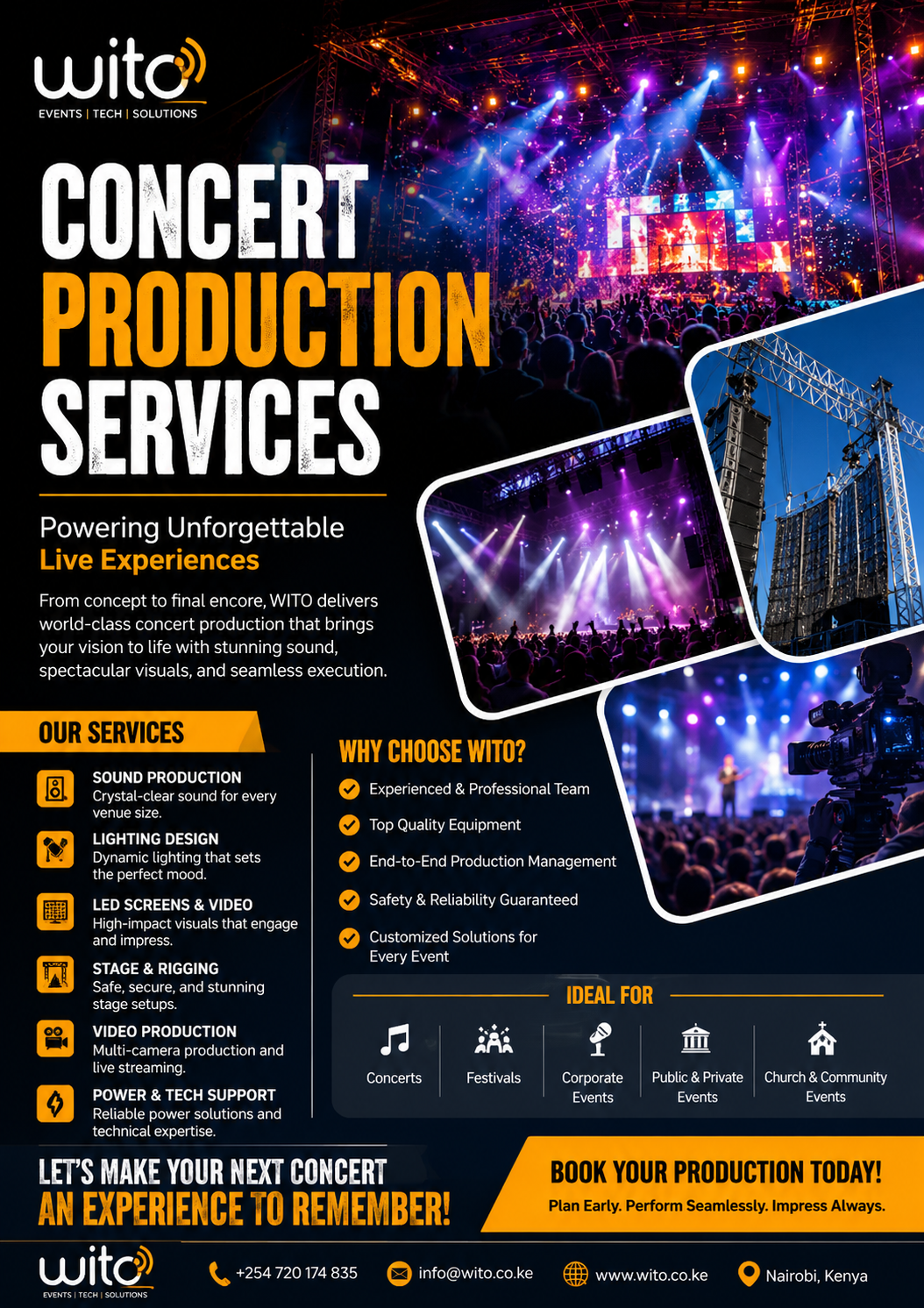
concert production services are essential for creating successful live music events that deliver high-quality sound, powerful visuals, professional stage presentation, and an engaging audience experience. From small live performances to large concerts and music festivals, professional production involves much more than putting performers on a stage.
A successful concert requires careful coordination between sound, lighting, staging, video, power, performers, technical crews, venue teams, security, and event organizers. Every element needs to work together to create a seamless experience for both the audience and the artists.
For event organizers in Kenya, investing in professional concert production services can make a significant difference in the quality and reliability of a live event. A well-produced concert allows audiences to hear performers clearly, see the stage properly, experience dynamic lighting and visuals, and enjoy an environment designed around the music.
What Are Concert Production Services?
Concert production services refer to the technical and operational services required to plan, prepare, execute, and manage a live music event.
These services can cover several areas, including:
- Stage production
- Professional sound systems
- Concert lighting
- LED screens
- Video production
- Stage design
- Trussing and rigging
- Power distribution
- Backline equipment
- Technical crew
- Live streaming
- Event recording
- Stage management
- Production coordination
The exact requirements depend on the size and type of concert.
A small indoor performance may require a compact sound system, basic stage lighting, microphones, and a technical operator.
A large outdoor concert may require line-array sound systems, multiple LED screens, moving-head lighting, large stage structures, generators, rigging systems, multiple technical teams, and extensive production planning.
Why Concert Production Matters
Music is the primary attraction at a concert, but production determines how effectively the audience experiences that music.
A great performer can deliver an excellent performance, but poor sound can make the vocals difficult to understand.
A talented musician can perform brilliantly, but inadequate lighting can make the stage visually uninteresting.
An exciting concert can lose its impact if the audience cannot clearly see the performers.
Professional concert production services bring these elements together.
The objective is to ensure that the technical environment supports the artist instead of distracting from the performance.
The Main Components of Concert Production
A professional concert typically involves several interconnected production areas.
Sound Production
Sound is one of the most important components of a concert.
The audience needs to hear:
- Vocals
- Instruments
- Bass
- Drums
- Backing tracks
- Announcements
- Special effects
The sound system must be designed according to the venue, audience size, stage configuration, and performance requirements.
Stage Production
The stage provides the physical environment where performers perform.
Stage production can include:
- Stage platforms
- Stage roofs
- Backdrops
- Stairs
- Ramps
- Trussing
- Stage branding
- Artist areas
- Equipment positions
Concert Lighting
Lighting creates atmosphere and directs attention.
It can include:
- Moving heads
- LED PAR lights
- Beam lights
- Wash lights
- Spotlights
- Strobes
- Follow spots
- Decorative lighting
Lighting can be programmed to respond to music and performance cues.
Video Production
Large concerts frequently use video technology.
This may include:
- LED screens
- IMAG screens
- Camera systems
- Video switching
- Live feeds
- Recorded content
- Stage visuals
Video allows audiences further from the stage to see performers more clearly.
Sound System Design for Concerts
Sound system design should begin with understanding the venue.
The technical team should assess:
- Venue size
- Audience capacity
- Stage location
- Audience layout
- Indoor or outdoor environment
- Expected sound levels
- Artist requirements
- Number of performers
A system that works well for a small hall may not be suitable for an outdoor festival.
Line Array Sound Systems
Large concerts often use line-array systems.
These systems can provide controlled sound coverage across large audience areas.
The configuration depends on:
- Audience size
- Venue dimensions
- Stage size
- Required coverage
- Sound pressure requirements
Proper deployment is essential.
Simply using powerful speakers does not guarantee good sound.
Front-of-House Sound
The front-of-house engineer controls the sound that the audience hears.
The mixing console may receive signals from:
- Lead vocals
- Backup vocals
- Guitars
- Keyboards
- Drums
- Bass
- Playback
- Guest instruments
The engineer balances these sources to create the desired sound.
Monitor Sound
Performers also need to hear themselves.
Stage monitors can provide musicians with the sounds they require during their performance.
Alternatively, artists may use in-ear monitoring systems.
Good monitoring helps performers stay synchronized and confident on stage.
Microphone Selection
Different performances require different microphones.
Vocal microphones should provide clear and reliable vocal reproduction.
Instrument microphones are selected according to the instrument and desired sound.
For example, microphones used for drums can differ significantly from those used for vocals.
The production team should understand the artist’s technical requirements before the event.
Digital Mixing Consoles
Modern concert productions frequently use digital mixing consoles.
These consoles can provide:
- Multiple channels
- Digital processing
- Equalization
- Compression
- Effects
- Scene recall
- Remote control
- Monitoring options
Digital systems can help engineers manage complex concerts efficiently.
Stage Management
Stage management coordinates what happens on stage.
A stage manager may coordinate:
- Artist entrances
- Artist exits
- Equipment changes
- Microphone changes
- Performance schedules
- Stage crew
- Backline requirements
This is especially important when several artists perform during one concert.
Concert Stage Design
Stage design affects both the audience experience and the visual identity of the event.
The stage may incorporate:
- LED screens
- Branding
- Lighting fixtures
- Trussing
- Platforms
- Artist risers
- Decorative structures
The design should provide enough space for performers while accommodating technical equipment.
Stage Size
Stage size depends on the number of performers and the type of concert.
A solo artist may require a relatively simple stage.
A band with drums, keyboards, guitars, backup singers, and dancers requires significantly more space.
Large concerts may require multiple stage platforms and artist risers.
Stage Branding
Concerts can provide significant branding opportunities.
Organizers may place branding on:
- Stage backdrops
- LED screens
- Side panels
- Trussing
- Entrance structures
- Sponsor displays
Digital screens can also display sponsor logos between performances.
Concert Lighting Design
Lighting helps create the visual identity of a concert.
A lighting designer may use different fixtures for:
- Artist illumination
- Audience lighting
- Backlighting
- Stage washes
- Effects
- Beams
- Special moments
The lighting design should support the music rather than overwhelm it.
Moving Head Lights
Moving heads can change position, color, beam direction, and intensity.
They are useful for creating dynamic concert environments.
They can be programmed for:
- Artist entrances
- Chorus sections
- Music transitions
- Dramatic moments
- Crowd interaction
Follow Spotlights
Follow spots allow operators to track performers as they move around the stage.
They are especially useful for:
- Main artists
- Guest performers
- Speakers
- Special entrances
Follow spots can ensure the audience’s attention remains on the intended performer.
LED Screens for Concerts
LED screens are increasingly important in modern concert production.
They can display:
- Artist visuals
- Music videos
- Graphics
- Animations
- Logos
- Sponsor messages
- Live camera feeds
For large audiences, screens can dramatically improve visibility.
IMAG Video
Image Magnification, commonly called IMAG, uses cameras to display live footage of performers on large LED screens.
This allows people sitting farther away from the stage to see:
- Facial expressions
- Instrument playing
- Performer movement
- Audience interaction
The camera team and LED screen operator need to work together to produce an engaging live feed.
Camera Production
Concert camera production can involve several camera positions.
Cameras may be placed:
- At front of house
- At stage sides
- Behind the audience
- On elevated platforms
- On stage
- On specialized camera systems
The number of cameras depends on the production requirements.
Video Switching
A video director or switcher can select which camera appears on the LED screen or livestream.
For example:
Camera 1 may show the lead singer.
Camera 2 may show the drummer.
Camera 3 may show the guitarist.
Camera 4 may provide a wide stage shot.
Switching between these angles creates a more dynamic visual experience.
Concert Streaming
Some concerts are broadcast online.
Live streaming can allow people who cannot attend physically to watch the performance remotely.
Streaming production may require:
- Cameras
- Video switchers
- Encoding
- Stable internet
- Audio feeds
- Streaming platforms
- Technical operators
The stream should be planned separately from the physical audience experience.
Power Management
Concerts use significant amounts of electrical equipment.
Power may be required for:
- Sound systems
- Lighting
- LED screens
- Video equipment
- Backline
- Production offices
- Charging stations
Power planning should happen early.
Outdoor concerts may require generators or other suitable power solutions.
Backup Power
Power interruptions can severely disrupt a concert.
Depending on the event, backup systems may be considered for critical production equipment.
The technical team should understand the power requirements and establish contingency plans.
Trussing and Rigging
Large concerts often require trussing for lighting and video equipment.
Trussing may support:
- Moving lights
- LED screens
- Speaker systems
- Decorative elements
- Signage
Rigging must be planned and executed safely.
Equipment should not be suspended without appropriate structural and rigging considerations.
Concert Production Safety
Safety should always be a major consideration.
Production teams need to manage:
- Electrical equipment
- Heavy speakers
- Lighting fixtures
- Rigging
- Cables
- Stages
- Crowd areas
- Weather conditions
A professional production team should establish appropriate safety procedures before equipment installation begins.
Outdoor Concert Production
Outdoor concerts introduce additional challenges.
Production teams need to consider:
- Weather
- Wind
- Rain
- Dust
- Ground conditions
- Power
- Audience movement
- Equipment protection
The production design should account for the environment from the beginning.
Weather Planning
Weather can affect equipment and audience safety.
Outdoor concert organizers should monitor weather conditions and have contingency procedures.
Where appropriate, sensitive equipment should have suitable protection.
Strong wind can also affect temporary structures and suspended equipment.
Concert Production Crew
A successful concert requires skilled people.
Depending on the scale of the event, the production team may include:
- Production manager
- Stage manager
- Sound engineer
- Monitor engineer
- Lighting designer
- Lighting operator
- Video director
- Camera operators
- LED technicians
- Rigging crew
- Stagehands
- Power technicians
- Backline technicians
Each role contributes to the overall production.
Production Manager
The production manager oversees the technical side of the concert.
Responsibilities may include:
- Planning
- Scheduling
- Equipment coordination
- Crew management
- Venue coordination
- Technical requirements
- Production logistics
The production manager helps ensure all departments work together.
Sound Engineer
The sound engineer manages the audience mix.
They balance instruments and vocals to create an appropriate sound.
They may also work with the artist’s technical team to understand the performance requirements.
Monitor Engineer
The monitor engineer focuses on what performers hear.
They may create separate monitor mixes for different musicians.
This allows each performer to hear the elements they need.
Lighting Operator
The lighting operator executes programmed lighting cues during the concert.
They may control:
- Colors
- Intensity
- Movement
- Effects
- Special cues
The operator works closely with the music and stage schedule.
Video Director
The video director controls the live camera feed.
They decide which camera should appear on:
- LED screens
- Streaming output
- Recording feed
This role is particularly important for large productions.
Stagehands
Stagehands assist with physical production tasks.
They may help with:
- Equipment movement
- Stage changes
- Microphone changes
- Backline
- Cable management
- Stage setup
Their work often happens behind the scenes but is essential to smooth production.
Concert Soundcheck
Soundcheck allows the technical team to test the system before the audience arrives.
It may include:
- Microphone checks
- Instrument checks
- Monitor checks
- Gain adjustments
- Equalization
- Speaker testing
Artists can also confirm that they can hear themselves properly.
Full Technical Rehearsal
For major concerts, a technical rehearsal can test the complete production.
The team may test:
- Lighting cues
- LED content
- Camera feeds
- Sound transitions
- Artist entrances
- Stage movements
- Special effects
This helps identify problems before the audience arrives.
Artist Technical Riders
Professional artists may provide technical riders.
A rider can specify:
- Microphones
- Instruments
- Monitor requirements
- Stage layout
- Backline
- Lighting preferences
- Hospitality requirements
The production team should review the rider early.
Why Technical Riders Matter
Ignoring an artist’s technical requirements can create problems on event day.
A rider gives the production team an understanding of what the artist expects.
It also helps organizers determine whether additional equipment needs to be sourced.
Concert Production Budgeting
A concert budget should account for all major production areas.
Potential costs include:
- Sound
- Lighting
- LED screens
- Stage
- Trussing
- Rigging
- Power
- Video
- Crew
- Transportation
- Setup
- Dismantling
- Technical support
The cheapest production quote is not always the best option.
A reliable technical setup can reduce the risk of expensive problems during the event.
Choosing Concert Production Services
When choosing a production company, consider:
- Experience
- Equipment quality
- Technical crew
- Previous events
- Safety practices
- Production planning
- Backup equipment
- Technical support
- Ability to handle the expected audience size
Ask the provider for a clear production proposal.
Venue Inspection
A venue inspection can identify potential problems before event day.
The production team can assess:
- Stage area
- Ceiling height
- Rigging points
- Power availability
- Audience layout
- Loading access
- Equipment storage
- Camera positions
This information can improve production planning.
Production Timeline
A concert should have a detailed production schedule.
This may include:
Load-in
Equipment arrives at the venue.
Stage setup
Stage and trussing are installed.
Audio setup
Sound systems and microphones are installed.
Lighting setup
Lighting fixtures are positioned and focused.
Video setup
LED screens and cameras are installed.
Soundcheck
The sound system is tested.
Rehearsal
Artists and production teams run through the show.
Doors open
Audience members enter.
Concert
The production team operates the event.
Load-out
Equipment is dismantled and removed.
Why Professional Planning Matters
A concert can involve hundreds of technical tasks.
Without a structured production plan, small mistakes can create major problems.
For example, a delayed stage setup can delay soundcheck.
A delayed soundcheck can affect artist preparation.
An incomplete LED screen setup can affect camera testing.
A power problem can affect the entire production.
Planning connects all these elements.
Concert Production for Different Events
Not every concert needs the same production package.
Small Indoor Concert
May require:
- Compact sound system
- Basic stage
- LED lighting
- Microphones
- Small LED screen
Corporate Concert
May require:
- Professional sound
- Stage design
- Branding
- LED screens
- Concert lighting
- Video production
Large Outdoor Concert
May require:
- Large PA system
- Multiple LED screens
- Large stage
- Trussing
- Moving lights
- Generators
- Cameras
- Production crew
Music Festival
May require:
- Multiple stages
- Large sound systems
- Extensive lighting
- LED screens
- Artist management
- Multiple technical crews
The production package should be designed around the event rather than based on a standard equipment list.
The Importance of Professional Concert Production
A successful concert is the result of many technical elements working together.
Sound must be clear.
Lighting must be visually engaging.
The stage must be safe and functional.
LED screens must display appropriate content.
Cameras must capture important moments.
Power must remain stable.
The production crew must communicate effectively.
This coordination is what makes professional concert production services valuable.
Concert Production Services: Sound, Lighting, Stage Design, LED Screens and Technical Management
concert production services play a critical role in transforming a live music performance into a professional and memorable event. While artists and performers are the center of a concert, the technical production surrounding them determines how effectively the audience experiences the performance.
A concert involves much more than a stage and speakers. It requires coordinated sound reinforcement, stage design, lighting, LED displays, video production, power management, technical crews, artist requirements, rehearsals, and event-day operations.
For organizers planning concerts, festivals, corporate entertainment events, church concerts, university shows, or large public performances, understanding these production elements makes it easier to plan an event that meets both audience and performer expectations.
Professional Concert Sound Production
Sound is arguably the most important technical element of a live concert.
If the audience cannot hear the performer clearly, even an excellent performance can lose its impact.
Professional concert production services therefore begin with careful sound planning.
The sound system should be designed around:
- Venue capacity
- Venue dimensions
- Audience layout
- Stage position
- Number of performers
- Type of music
- Expected sound levels
- Indoor or outdoor environment
A small acoustic concert may require a very different system from a large outdoor music festival.
Main Sound System Components
A professional concert sound system can include:
- Main speakers
- Subwoofers
- Front fills
- Delay speakers
- Stage monitors
- Microphones
- Digital mixing consoles
- Signal processors
- Amplifiers
- Wireless systems
- Cabling
- Audio distribution equipment
Each component has a specific role.
The objective is to create consistent sound coverage across the audience area.
Main PA System
The main PA system delivers sound to the audience.
For larger concerts, line-array speaker systems may be used to provide controlled coverage across a wide area.
The system needs to be positioned and configured according to the venue.
Poor speaker placement can result in some audience members receiving excessive sound while others struggle to hear.
Subwoofers
Subwoofers reproduce low-frequency sounds.
They are particularly important for music genres where bass and drums are a major part of the performance.
A properly configured subwoofer system can give a concert greater impact without simply increasing overall volume.
Front Fill Speakers
People seated near the front of the stage may not receive the same sound coverage as people farther back.
Front-fill speakers can help provide more consistent coverage in the immediate area in front of the stage.
This is particularly useful for large stages.
Delay Speakers
Large venues may require additional speakers positioned farther from the main stage.
These delay systems can help deliver sound to distant audience areas.
The timing of these systems must be carefully configured to maintain synchronization with the main sound system.
Stage Monitoring
Performers need to hear themselves and other musicians.
Stage monitors provide sound directly to performers.
A singer may need to hear their voice.
A guitarist may need vocals and drums.
A drummer may need the entire rhythm section.
Each performer can therefore require a different monitor mix.
In-Ear Monitoring
In-ear monitors provide performers with audio through specialized earpieces.
They can help reduce stage noise and provide consistent monitoring.
They are commonly used in professional concerts where performers require precise audio control.
Digital Audio Mixing
Digital mixing consoles allow engineers to control large numbers of audio channels.
A concert may have separate channels for:
- Lead vocals
- Backup vocals
- Guitar
- Bass
- Keyboard
- Kick drum
- Snare
- Toms
- Cymbals
- Playback
- Guest instruments
The engineer balances these channels to produce the desired audience mix.
Concert Lighting Production
Lighting is another major component of professional concert production services.
Concert lighting creates atmosphere, emphasizes performers, supports musical transitions, and gives the event a distinctive visual identity.
A lighting design can change throughout the performance.
A slow song may use softer lighting.
An energetic performance may use fast-moving beams and dynamic effects.
Common Concert Lighting Equipment
Concert lighting can include:
- Moving head lights
- Beam lights
- Wash lights
- LED PARs
- Spotlights
- Strobes
- Follow spots
- Blinders
- Pixel lights
- Effect lighting
The equipment selected depends on the stage and production requirements.
Moving Head Lighting
Moving head fixtures can move vertically and horizontally while changing colors and beam characteristics.
They are useful for creating dynamic visual effects.
Lighting operators can program different movements and cues for different songs.
Wash Lighting
Wash lights provide broad illumination.
They can be used to light:
- Performers
- Stage areas
- Backdrops
- Audience areas
Different colors can create different moods.
Beam Lighting
Beam lights produce narrow, intense beams.
They are particularly effective in darker venues where the beams can be clearly seen.
Multiple beam fixtures can create dramatic patterns across the stage and audience.
Strobe Effects
Strobe lights create rapid flashes.
They can be used during energetic sections of a concert, but they should be operated responsibly because flashing lights can affect people who are sensitive to them.
Follow Spots
Follow spots allow operators to track specific performers.
They are particularly useful for:
- Main artists
- Guest performers
- Special entrances
- Featured musicians
This ensures that important performers remain visually prominent.
Lighting Control
Lighting systems are controlled through professional lighting consoles.
The lighting operator can program cues for:
- Color
- Movement
- Brightness
- Timing
- Effects
- Transitions
For major concerts, lighting cues can be synchronized with the performance schedule.
Stage Design
Stage design determines how the performance environment looks and functions.
A well-designed stage should provide adequate space for performers while accommodating technical equipment.
Stage design can include:
- Platforms
- Risers
- Backdrops
- LED screens
- Trussing
- Branding
- Stairs
- Decorative structures
The design should reflect the identity of the concert.
Stage Risers
Risers can elevate musicians and performers.
For example, a drummer may be positioned on a raised platform at the back of the stage.
Other musicians may also use risers depending on the stage design.
This can improve visibility for the audience.
Concert Stage Backdrops
Backdrops can carry:
- Event branding
- Artist graphics
- Sponsor logos
- Event themes
- Digital content
For modern productions, physical backdrops are often combined with LED screens.
LED Screens in Concert Production
LED screens have become a major feature of modern concerts.
They provide large, bright visual surfaces that can display content throughout the event.
An LED screen can show:
- Artist visuals
- Live camera feeds
- Animations
- Lyrics
- Event branding
- Sponsor advertisements
- Music videos
- Graphics
A professional concert production services provider can recommend appropriate screen sizes and configurations based on audience distance and stage design.
Main Stage LED Screens
A large LED screen positioned behind performers can serve as the visual centerpiece of the stage.
It can display content synchronized with the music.
This gives artists an opportunity to create a distinctive visual environment.
Side LED Screens
Large concerts may also use side screens.
These can display live camera feeds to audiences positioned at the sides or farther away from the main stage.
Side screens are particularly useful at large outdoor venues.
LED Screen Content
The quality of the content displayed on an LED screen matters as much as the screen itself.
Content may include:
- Motion graphics
- Artist names
- Song visuals
- Branding
- Sponsor messages
- Animations
- Live video
The content should be designed according to the screen’s resolution and aspect ratio.
Live Camera Production
Camera systems can significantly improve the concert experience.
Cameras can capture performers from multiple angles.
Potential camera positions include:
- Front of stage
- Side of stage
- Rear of audience
- Elevated platforms
- FOH position
The video director selects the best shots for the audience screens or online stream.
IMAG Production
Image Magnification allows live camera footage to be shown on large LED screens.
This is particularly valuable for large venues.
People far from the stage may not be able to see an artist’s face clearly.
A live camera feed allows them to experience the performance more closely.
Video Switching
Video switching is the process of selecting which camera feed is displayed.
The video director may switch between:
- Wide shots
- Close-ups
- Artist shots
- Crowd shots
- Instrument shots
- Stage shots
Good switching follows the rhythm and action of the performance.
Concert Visual Effects
Visual effects can help create memorable performances.
These may include:
- Animated backgrounds
- Motion graphics
- Video loops
- Artist visuals
- Lighting effects
- Screen transitions
Visual content should complement the artist’s performance.
Backline Equipment
Backline refers to instruments and related equipment used by performers.
Depending on the concert, this may include:
- Drum kits
- Guitar amplifiers
- Bass amplifiers
- Keyboards
- Stands
- Pedals
- DI boxes
Some artists bring their own equipment, while others rely on equipment supplied by the production team.
Artist Technical Riders
Artists may provide technical riders outlining their requirements.
The rider can specify:
- Microphones
- Monitors
- Instruments
- Backline
- Stage layout
- Lighting requirements
- Input lists
- Hospitality requirements
Production teams should review technical riders early.
This provides enough time to source additional equipment where necessary.
Stage Plot
A stage plot shows where performers and equipment should be positioned.
It may show:
- Drum kit
- Bass position
- Guitar positions
- Keyboard
- Vocal microphones
- Monitor speakers
- DI boxes
- Risers
The stage crew uses the plot during setup.
Input List
An input list identifies the audio sources that will be connected to the mixing console.
For example:
- Kick drum
- Snare
- Hi-hat
- Tom 1
- Tom 2
- Bass
- Guitar
- Keyboard
- Lead vocal
- Backup vocal
This makes audio setup more organized.
Power Distribution
Concert equipment requires reliable electrical power.
Power planning should account for:
- Audio systems
- Lighting
- LED screens
- Video systems
- Backline
- Production offices
- Other technical equipment
The production team should understand total power requirements before installation.
Generator Solutions
Outdoor concerts may require generators.
The generator system should be appropriately sized for the equipment being powered.
Critical production systems may also require backup power planning.
Cable Management
Concerts involve large quantities of cables.
These may include:
- Audio cables
- Power cables
- Network cables
- Video cables
- Lighting cables
Cables should be routed and secured properly to reduce trip hazards and equipment problems.
Trussing
Trussing provides a structural framework for production equipment.
Lighting fixtures, LED screens, speakers, and other equipment may be supported by truss structures where appropriate.
The design and installation must account for equipment weight and structural requirements.
Rigging
Rigging requires professional planning and execution.
Suspended equipment should be installed by qualified personnel using appropriate equipment and procedures.
The production team should understand:
- Load requirements
- Suspension points
- Equipment weight
- Safety margins
- Venue restrictions
Safety should never be compromised to achieve a particular visual design.
Concert Safety Planning
Safety is a fundamental part of concert production services.
The production team should identify potential hazards before setup.
These may include:
- Electrical risks
- Heavy equipment
- Suspended equipment
- Stage edges
- Cables
- Weather
- Crowd movement
Appropriate safety procedures should be established for the event.
Outdoor Concert Challenges
Outdoor concerts require additional preparation.
Production teams may have to deal with:
- Wind
- Rain
- Dust
- Heat
- Uneven ground
- Limited power
- Long cable runs
Equipment should be selected and installed according to environmental conditions.
Weather Contingency Planning
Weather conditions can change quickly.
Event organizers should establish contingency plans before the concert.
These may include:
- Equipment covers
- Covered technical areas
- Alternative power arrangements
- Weather monitoring
- Audience shelter
- Schedule adjustments
The safety of performers, staff, and attendees should remain the priority.
Concert Production Crew
Professional concert production services rely on experienced technical personnel.
A larger production may include:
- Production manager
- Stage manager
- Sound engineer
- Monitor engineer
- Lighting designer
- Lighting operator
- Video director
- Camera operators
- LED technicians
- Rigging technicians
- Stagehands
- Power technicians
Each person has a specific responsibility.
Production Manager
The production manager coordinates the technical operation.
They may manage:
- Production schedules
- Equipment
- Crew
- Venue coordination
- Artist requirements
- Technical rehearsals
They are often responsible for ensuring that different departments work together.
Stage Manager
The stage manager coordinates activities directly around the stage.
They may manage:
- Artist entrances
- Stage changes
- Equipment changes
- Microphone changes
- Performance timing
This role is particularly important when many artists are performing.
Sound Engineer
The sound engineer manages the audience audio mix.
Their goal is to provide clear and balanced sound throughout the venue.
Monitor Engineer
The monitor engineer manages the sound performers hear.
Different musicians may require different monitor mixes.
Lighting Designer
The lighting designer creates the visual lighting concept.
They determine:
- Fixture positions
- Colors
- Movement
- Effects
- Lighting cues
Video Director
The video director manages live camera feeds.
They determine what appears on the LED screens or streaming output.
Stagehands
Stagehands help with equipment movement and stage changes.
They often work quickly between performances to prepare the stage for the next artist.
Technical Rehearsals
A technical rehearsal is an important part of professional concert preparation.
The team can test:
- Audio
- Lighting
- LED screens
- Cameras
- Stage movements
- Artist entrances
- Playback
- Special cues
Problems identified during rehearsal can be corrected before the audience arrives.
Soundcheck
Soundcheck allows engineers and performers to verify the audio system.
The process may include:
- Line check
- Microphone check
- Instrument check
- Monitor check
- Front-of-house mix
- Artist rehearsal
This helps ensure the system is ready.
Full Dress Rehearsal
For major productions, a full rehearsal can run through the entire event.
This may include:
- Artist entrances
- Lighting cues
- Video cues
- Stage movements
- Performance transitions
- Announcements
A full rehearsal gives the production team a realistic understanding of how the show will operate.
Concert Event Timeline
A typical production timeline can include:
Pre-Production
Planning begins weeks or months before the concert.
Venue Inspection
The production team evaluates the site.
Equipment Planning
The required production equipment is identified.
Load-In
Equipment arrives at the venue.
Setup
Technical systems are installed.
Testing
Each system is tested.
Soundcheck
Artists and engineers test audio.
Rehearsal
The complete production is rehearsed.
Doors Open
Audience members enter.
Live Concert
The production team operates the event.
Load-Out
Equipment is dismantled and transported away.
Why Professional Coordination Matters
Every department affects another.
For example, the LED screen position can affect lighting placement.
Lighting positions can affect camera shots.
Stage size can affect speaker placement.
Speaker placement can affect audience coverage.
Power requirements affect equipment planning.
This is why experienced concert production services providers coordinate departments from the beginning instead of treating each technical element as an isolated service.
Production Planning for Different Concert Sizes
A production package should match the event.
Small Concert
A small concert may require:
- Compact sound system
- Basic lighting
- Stage
- Microphones
- Small LED display
Medium Concert
A medium event may require:
- Larger sound system
- Multiple lighting fixtures
- LED screens
- Stage risers
- Video cameras
- Technical crew
Large Concert
A large concert may require:
- Line-array sound
- Multiple subwoofers
- Large LED walls
- Side screens
- Extensive lighting
- Trussing
- Rigging
- Generators
- Multiple cameras
- Large production team
Budgeting for Concert Production
Budget planning should begin early.
Major production costs can include:
- Sound equipment
- Lighting
- LED screens
- Stage
- Trussing
- Rigging
- Video
- Power
- Crew
- Transportation
- Setup
- Dismantling
The organizer should receive a clear quotation explaining what is included.
Avoiding Unexpected Production Costs
Ask the production company whether the quotation includes:
- Transport
- Setup
- Dismantling
- Operators
- Technical support
- Rehearsal
- Backup equipment
- Power requirements
Understanding these details early can prevent unexpected expenses.
Selecting a Concert Production Company
When evaluating concert production services, consider the provider’s experience with events similar to yours.
Ask about:
- Previous concerts
- Equipment inventory
- Technical crew
- Safety procedures
- Backup systems
- Production planning
- Venue experience
- Technical support
Experience with similar events can be particularly valuable.