Free event management software has democratized event operations for organizations that previously couldn’t afford traditional paid platforms. Whether you’re running a church with 200 members, managing a chama’s monthly contributions, coordinating a school fundraiser, or organizing a nonprofit conference, free event management software delivers core functionality—registration, ticketing, contribution tracking, communication, check-in, and reporting—at zero cost. This comprehensive guide explores free event management software options specifically suited for African organizations, where budget constraints are real and paid software licensing feels prohibitively expensive. The reality is that free event management software has matured dramatically, offering surprisingly complete feature sets that rival expensive competitors.
Fifteen years ago, free event management in software was a contradiction in terms. Event organizations either built spreadsheet systems themselves or paid enterprise prices for dedicated platforms. Today’s landscape is radically different. Free event management in software now powers hundreds of thousands of events globally—from corporate meetings to community gatherings to professional conferences. The shift reflects both vendor economics (cloud infrastructure costs have plummeted) and market recognition that free tiers generate network effects, brand loyalty, and eventual upsell opportunities. For budget-conscious organizations across Kenya and East Africa, free event management in software is no longer a compromise—it’s the first smart choice.
Table of Contents
- Why Free Event Management Software Matters
- Understanding Free Event Management Software Models
- Top Free Platforms for Community Organizations
- Core Features Available in Free Event Management Software
- Limitations and Trade-Offs of Free Event Management Software
- Free Event Management Software for Specific Use Cases
- Moving Beyond Free: When to Upgrade
- Implementation Tips for Free Event Management Software
Why Free Event Management Software Matters
For many organizations across Kenya and Africa, paid event management software isn’t an option. A 150-member church might have a 50,000 KES annual budget for all technology—free event management software makes event operations possible within that reality. A chama managing member contributions can’t justify a 1,500 KES monthly subscription when margins are thin. A school organizing its annual fundraiser operates with volunteer labor and minimal budget. Free event management in software enables these organizations to operate professionally despite financial constraints.
The impact is concrete. A Nairobi church using free event management in software reduced its administrative workload by 60%. Contribution tracking that previously consumed 8 hours monthly now takes 1.5 hours. Members receive WhatsApp payment reminders automatically rather than coordinators sending them manually. Attendance is tracked via QR code instead of sign-in sheets. Zero-cost digital tools delivered this transformation.
Free event management in software also levels the playing field between well-resourced organizations (which can afford enterprise solutions) and grass-roots organizations (which previously had no viable tools). A small nonprofit using free event management in software can operate nearly as effectively as a large organization with expensive software—the primary difference is support and premium features, not core functionality. This democratization is accelerating organizational professionalization across the continent.
Understanding Free Event Management Software Models
Free event management in software doesn’t mean the vendors operate at a loss. Understanding the business models behind free event management in software clarifies what to expect and when vendors might change terms.
Freemium Model – The most common free event management insoftware structure is freemium: a robust free tier serves small organizations (up to 500 members, 1–2 events monthly), while premium features (advanced analytics, custom branding, API access, dedicated support) unlock through paid subscription. Free event management in software freemium tiers capture customers, demonstrate value, and hope a percentage upgrade to paid plans as they scale. This model aligns vendor incentives with user success—free event management in software providers are motivated to make free tiers powerful enough to solve real problems, not just be teaser versions.
Ad-Supported Model – Some free event management in software platforms generate revenue through advertising, allowing vendors to offer zero-cost software. This model works when user bases are large enough to support ad-based economics. Concerns arise if ads become intrusive or vendor incentives shift toward maximizing ad exposure rather than user experience. Free event management in software with ad support is viable for some use cases but less ideal for organizations prioritizing data privacy or professional experience.
Open-Source Model – Open-source free event management in software (like Indico or Pretalx) operates under open-source licenses, allowing anyone to download, modify, and self-host the software. These platforms are genuinely free—no vendor business model, no potential for future pricing changes. The trade-off: open-source free event management in software requires technical expertise to install, configure, and maintain. They’re powerful for tech-savvy organizations but impractical for most community groups.
Loss-Leader Model – Some vendors offer free event management in software to build market share with a long-term goal of monetizing through add-ons, migrations, or bundled offerings. These free event management in software providers must be monitored—they might eventually eliminate free tiers or dramatically reduce free tier functionality if business models shift.
Understanding which model underpins your free event management in software choice helps predict long-term viability and risk of terms changes. Freemium models are generally most stable because they’re proven business models aligned with user success.
Top Free Platforms for Community Organizations
Several free event management in software platforms serve community organizations well, with particular strength in African markets.
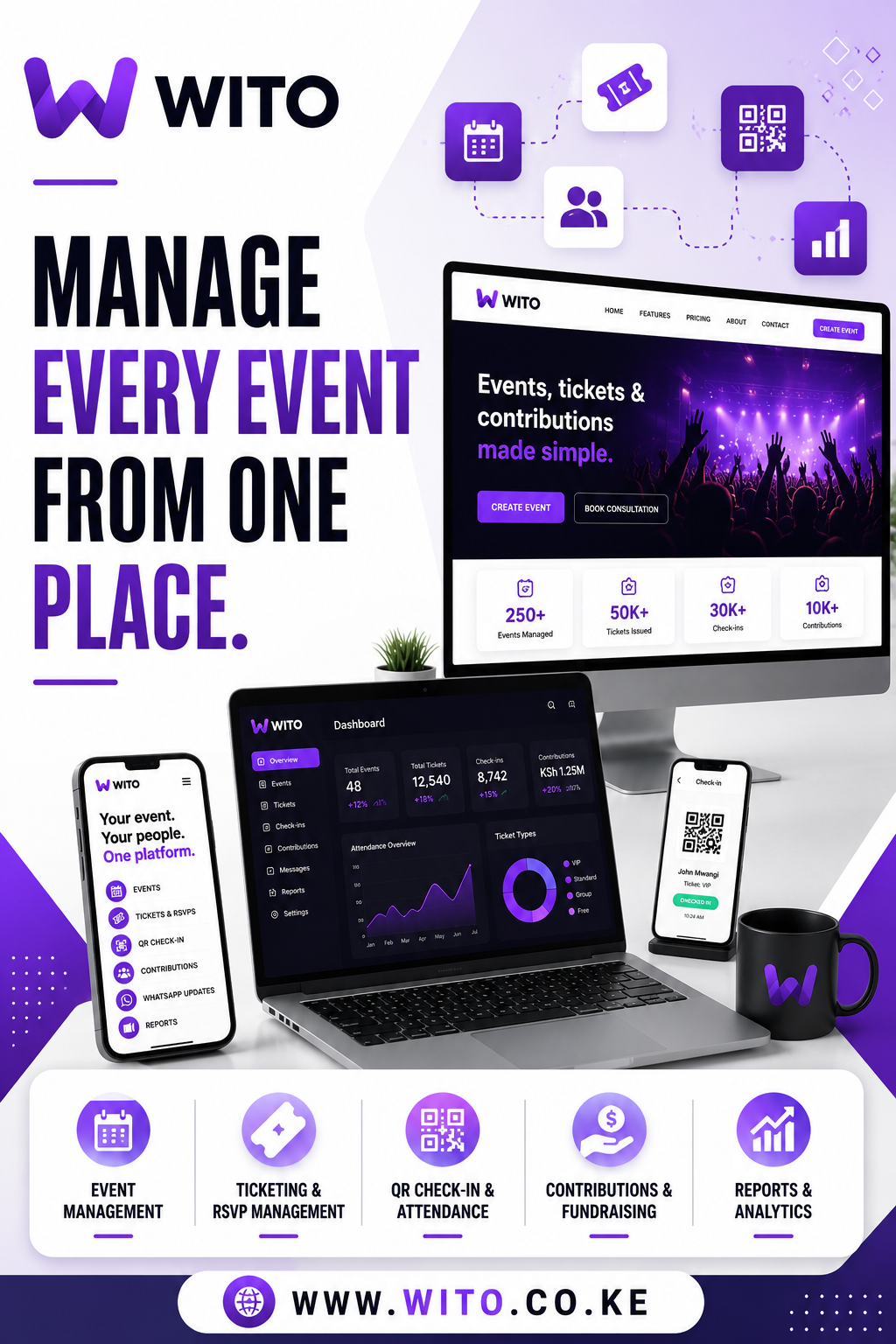
Wito: Free for Community Organizations – Wito offers a generous free tier specifically designed for community organizations, churches, chamaas, schools, and nonprofits. Free event management in software on Wito includes: unlimited members, unlimited events, WhatsApp integration, M-Pesa payment collection, contribution tracking, QR check-in, mobile app access, and basic reporting. Organizations under 500 members with 1–2 monthly events operate completely free. This free event management in software tier is so comprehensive that most small organizations never need to upgrade.
Wito’s free event management in software approach reflects the vendor’s recognition that community organizations are the primary market in Africa—pricing should reflect that reality rather than penalizing grassroots operations for being small.
Google Forms + Google Sheets (DIY Free Event Management Software) – The ultimate free event management software is building your own using Google’s free tools. Google Forms handles registration; Google Sheets tracks data; Google Docs creates printable check-in lists. This free event management in software approach requires technical setup but is genuinely cost-free. Limitations: no real-time dashboards, no automated communication, no mobile app. But for small, simple events, free event management in software DIY approach works.
Eventbrite Free Tier – Eventbrite offers free event management in software for organizations creating events free of charge (zero-ticket-price events). Their free event management in software includes registration, ticketing, check-in, and basic reporting. Limitation: Eventbrite makes money on payment processing fees if you sell tickets; their free event management in software is primarily for non-ticketed events. For ticketed events, Eventbrite’s free event management in software isn’t viable because processing costs aren’t free.
Splash – Splash offers a free tier for small events (under 500 attendees, basic features). Their free event management in software includes registration, customizable event pages, check-in, and email communication. Splash’s free event management in software is clean and user-friendly but has more limitations than Wito or Eventbrite for small organizations.
Hubb – Hubb provides free event management in software for organizations with under 100 attendees. Their free event management software includes registration, networking features, live streaming integration, and mobile app access. Hubb’s free event management software is generous but works best for specific event types (conferences, professional gatherings) rather than ongoing community management.
Lunchbox – Lunchbox offers free event management software focused on ticketed events. Their free event management software includes registration, ticket sales, and check-in but takes a commission on ticket sales rather than charging upfront subscription. For free event management software where you control pricing, Lunchbox is viable if you’re selling tickets and can absorb commission costs.
Core Features Available in Free Event Management Software
Free event management software has become surprisingly capable. Modern free event software typically includes:
Event Creation and Customization – Free event software lets you create events, set dates and times, describe programs, upload images, and customize event pages with branding. Most free event software allows at least basic customization; premium tiers unlock advanced styling and white-labeling.
Registration and RSVP Workflow – Free event software captures attendee information at registration, allows customizable registration forms, sets capacity limits, and manages RSVP tracking. Most free event software handles RSVPs well—this is table-stakes functionality.
Payment Collection – Many free event software platforms include payment processing (though they take a commission or transaction fee). Free event software supporting M-Pesa is rare but essential for African organizations; Wito’s free tier includes M-Pesa, making it exceptional among free event software options.
Email and SMS Communication – Free event software typically includes email broadcast capability (send messages to all registrants). Some free event management software includes SMS; fewer include WhatsApp. Wito’s free event management software uniquely prioritizes WhatsApp, recognizing it as the primary communication channel in Africa.
Mobile Check-In – Free event software increasingly includes QR-based check-in via mobile devices. This was previously a premium feature but is now standard in most free event software tiers.
Attendee Tracking and Lists – Free event software stores attendee data, tracks RSVPs, and generates attendee lists. Most free event software allows exporting data to CSV or spreadsheet format.
Basic Reporting and Analytics – Free event software provides basic dashboards showing total registrations, check-in counts, and demographic breakdowns. Advanced analytics (heat maps, behavior prediction, ROI modeling) typically remain behind paywalls in free event software.
Collaboration and Permissions – Most free event software allows multiple team members to access the system with role-based permissions (some members manage events, others manage registrations, others view reports only).
What free event software typically lacks compared to paid versions: advanced customization, priority support, high-volume capability, white-labeling, API access, advanced automation, and premium integrations. For most community organizations, these limitations are theoretical—they don’t affect actual event operations.
Limitations and Trade-Offs of Free Event Software
Free event software isn’t universally optimal. Understanding limitations helps you choose appropriately.
Attendee Volume Caps – Most free event software sets maximum attendee counts (typically 500–1,000). If you exceed these limits, you must upgrade to paid plans. For large conferences, free event management software becomes unviable. For community events, volume caps rarely matter.
Feature Limitations – Free event software reserves advanced features for paid tiers. Customization depth, reporting granularity, integration options, and automation sophistication typically differ between free and paid plans. For basic events, free event software features suffice. For complex multi-track conferences or enterprise events, limitations bite.
Vendor Risk – Free event software services can be discontinued if vendors exit the market or eliminate free tiers. This risk is manageable—most established free event software providers (Wito, Eventbrite, Google) are unlikely to vanish—but it’s a consideration. Switching between free event management software platforms is disruptive.
Data Export and Portability – Some free event management software limits data export (preventing you from accessing your attendee data if you want to switch platforms). Responsible vendors allow free event management software users to export data, but verify this before committing.
Support and Documentation – Free event management software often lacks priority support. Self-service documentation and community forums become your support channel. If you encounter problems, resolution may be slow. For organizations with technical staff or volunteers, this is manageable. For non-technical organizations, limited free event management software support is frustrating.
Branding and White-Labeling – Most free event management software displays vendor branding on event pages and emails. Paid tiers allow custom branding. For professional events, this is a limitation worth considering.
Advertising and Privacy – Some free event management software includes advertising or sells anonymized user data. Understand data privacy practices before choosing free event management software—some vendors’ free tiers are ad-supported, potentially distracting to attendees.
Payment Processing Fees – Even free event management software typically charges payment processing fees (2–3% + transaction fees) when attendees pay for tickets or contributions. This isn’t unexpected but is worth including in your cost model when evaluating free event management software.
Free Event Management Software for Specific Use Cases
Free event management software varies in suitability by use case. Matching platform to purpose ensures you select the right tool.
Churches and Religious Organizations – Free event management software for churches should handle contribution tracking, WhatsApp communication, offline capability, and M-Pesa integration. Wito’s free tier excels here; most other free event management software doesn’t accommodate religious-organization-specific workflows well.
Chamaas and Informal Investment Groups – Free event management software for chamaas needs contribution tracking, member communication, attendance records, and financial reporting. Wito’s free event management software is purpose-built for this use case. Generic free event management software (Eventbrite, Google Forms) requires significant workarounds to manage chama workflows.
Schools and Educational Events – Free event management software for schools needs student management, parent communication, and often parent payment options. Many generic free event management software platforms work adequately for school events if the school is willing to manage the tool’s limitations.
Nonprofits and Fundraisers – Free event management software for fundraising should track donations, generate receipts, and provide reporting for transparency communications. Eventbrite’s free tier works for free fundraising events; for ticketed fundraisers, the commission costs may be prohibitive and paid alternatives might be more cost-effective.
Corporate and Professional Meetings – Free event management software for corporate events often feels underpowered because corporate organizers expect polished branding, integration with corporate systems (calendar, email, CRM), and professional reporting. Free event management software is viable for small internal meetings but questionable for client-facing professional events.
Festivals and Entertainment Events – Free event management software for festivals and entertainment events emphasizes attendee experience, mobile app functionality, and integration with social media. Some free event management software handles this well; others less so.
Community Meetups and Workshops – Free event management software is excellent for grassroots community gatherings—meetups, workshops, seminars. Eventbrite and similar platforms were designed for this use case and excel here.
Moving Beyond Free: When to Upgrade
Free event management software serves organizations well until they outgrow free-tier limitations. Recognizing when to upgrade prevents frustration.
Volume Thresholds – When your events regularly exceed free event management software attendee caps, upgrading is necessary. This typically happens at 1,000–5,000 attendees, depending on the platform.
Feature Requirements – When free event management software lacks features you need (advanced networking, integration with external systems, custom branding, detailed analytics), paid versions become cost-justified. Calculate whether the time savings and capability gains justify paid subscription costs.
Support Needs – When free event management software support channels are insufficient and problems go unresolved, paid tiers with priority support become valuable. This typically affects organizations large enough to warrant professional IT support.
Scale and Professionalization – Growing organizations often perceive that free event management software is “not professional enough.” This is partially psychology—free often feels cheap. However, there’s a real correlation: paid platforms offer premium UX and branding that project professionalism. When event reputation matters significantly, paid versions justify investment.
Integration Requirements – When you need your event management software to integrate with CRM, accounting, email marketing, or other business systems, free event management software becomes limiting. Paid platforms typically offer better API access and integration ecosystems.
Upgrade Path Strategy – Responsible free event management software vendors make upgrading obvious. When you’ve genuinely outgrown free tiers, pricing and upgrade flows should clarify the next step. Good free event management software vendors invest in onboarding free tier users (building loyalty) and make premium features compelling enough to justify costs.
Successfully using free event management software requires clear planning and realistic expectations.
Start Small and Test – Don’t launch your first major event on a new free event management software platform. Test the platform with a small pilot event first. Identify limitations and workarounds before depending on the system at scale.
Learn the Interface Thoroughly – Free event management software vendors offer less hands-on training than paid platforms. Invest time learning the platform before using it for production events. Explore all features, test workflows, and understand data flows before launch.
Plan Data Migration – If you’re switching from manual processes (spreadsheets, sign-in sheets, manual tracking) to free event management software, plan data migration. Manually entering historical attendee data is tedious but ensures continuity and allows leveraging historical insights.
Document Your Workflows – Write down how you’ll use free event management software: registration flow, payment process, communication cadence, check-in procedures, reporting schedule. Documentation prevents mistakes and enables consistency across events.
Train Team Members – If multiple people manage the event with free event management software, train them on the platform. Create written guides (screenshots, step-by-step instructions) because free event management software support may not be available when questions arise.
Automate Where Possible – Free event management software often allows automation (triggered emails, scheduled messages, automatic reminders). Set up automation once and it runs repeatedly, saving manual work across future events.
Monitor Vendor Changes – Free event management software terms can change. Monitor your vendor’s announcements for pricing changes, feature deprecations, or policy changes. Build contingency plans in case free tiers are eliminated.
Maintain Data Backups – Export your attendee data regularly from free event management software. If the vendor eliminates free tiers or you need to migrate platforms, you’ll have data backups ensuring continuity.