Customizable event ticketing software has become an essential solution for organizations that want complete control over how they create, manage, and deliver events. Every event is unique, and using a one-size-fits-all ticketing platform often limits an organizer’s ability to provide a personalized experience. Whether you are organizing a corporate conference, church convention, university graduation, charity fundraiser, music concert, trade exhibition, sports tournament, networking event, or government forum, customizable event ticketing software allows you to tailor registration forms, ticket categories, branding, payment options, attendee communication, and event workflows to match your exact requirements.
Modern event organizers expect more than simply selling tickets online. They need a platform that reflects their organization’s identity, adapts to different event types, automates repetitive tasks, and provides valuable insights that help improve future events. This is where customizable solutions stand out. Instead of forcing organizers to change their processes, they allow the software to adapt to the event.
Organizations across Kenya and around the world are embracing digital transformation, making flexibility one of the most important considerations when selecting an event management platform. Whether your organization hosts ten events a year or hundreds, investing in customizable event ticketing software provides the scalability and adaptability needed to support long-term growth.
Table of Contents
- Introduction
- Why Flexibility Matters in Event Management
- Understanding Customizable Ticketing Platforms
- Features Every Flexible Platform Should Include
- Custom Registration Forms
- Flexible Ticket Categories
- Branding and Personalization
- Payment Gateway Integration
- QR Code Check-In
- Reporting and Analytics
- Choosing the Right Platform
- Kenya’s Growing Digital Events Industry
- Conclusion
Introduction
No two events are identical. A university graduation requires different registration information than a business conference. A church convention may need ministry or parish details, while a corporate seminar may require company names, job titles, and networking preferences. This diversity makes customizable event ticketing software an increasingly valuable investment for organizations seeking efficiency without sacrificing flexibility.
Traditional ticketing systems often provide fixed registration forms, limited branding options, and rigid workflows. These limitations force organizers to adapt their events to fit the software instead of allowing the software to support their event goals.
Modern customizable platforms solve this challenge by giving organizers complete control over event configuration. From ticket pricing and registration fields to automated emails and attendee categories, every component can be adjusted to suit the event.
This flexibility helps organizations create more engaging attendee experiences while reducing administrative work and improving operational efficiency.
Why Flexibility Matters in Event Management
Every event has different objectives, audiences, budgets, and operational requirements. A fundraising gala requires donation tracking, while a sports tournament may require team registrations and player information. A conference often involves multiple breakout sessions, while an exhibition needs exhibitor management.
Using customizable event ticketing software enables organizers to accommodate these differences without relying on multiple disconnected tools.
Flexible platforms allow organizers to:
- Design registration forms for specific events.
- Create unlimited ticket categories.
- Set custom pricing rules.
- Configure registration deadlines.
- Customize attendee communications.
- Manage event capacity.
- Integrate payment gateways.
- Generate detailed reports.
Rather than forcing every event into the same structure, customizable software provides the freedom to create workflows that match organizational requirements.
For organizations managing multiple event types throughout the year, this flexibility significantly reduces operational complexity while improving consistency.
Understanding Customizable Ticketing Platforms
A customizable ticketing platform is designed to adapt to different event requirements instead of following a rigid template.
With customizable event ticketing software, administrators can personalize nearly every aspect of event management, including registration, payments, branding, communications, reporting, and attendee access.
For example, a university may require student admission numbers during registration, while a business conference may collect company names, industries, and job titles. A charity fundraiser may ask participants whether they wish to make additional donations, while a sports competition may collect team information.
Because every event captures different information, flexible registration forms become one of the most valuable features offered by customizable platforms.
The ability to configure workflows also makes it easier for organizations to standardize operations across multiple departments while still allowing each event to maintain its unique identity.
Features Every Flexible Platform Should Include
When evaluating customizable event ticketing software, organizations should look beyond basic ticket sales. A professional solution should support the complete event lifecycle while remaining easy to configure.
Essential features include:
Easy Event Creation
Organizers should be able to create professional event pages within minutes by adding event descriptions, schedules, venues, speaker profiles, sponsors, ticket information, and branding.
A simple interface encourages adoption across different departments without requiring technical expertise.
Custom Registration Forms
Every event collects different participant information.
The platform should allow organizers to add custom fields such as:
- Full name
- Email address
- Phone number
- Organization
- Job title
- Student ID
- Dietary requirements
- Emergency contacts
- County
- Country
- Accessibility requirements
- Preferred sessions
This flexibility improves data collection while reducing unnecessary questions for attendees.
Flexible Ticket Categories
A professional platform should support unlimited ticket types, including:
- Early Bird
- VIP
- Standard Admission
- Student Tickets
- Complimentary Passes
- Speaker Passes
- Sponsor Packages
- Exhibitor Tickets
- Media Accreditation
- Group Registrations
Different ticket categories allow organizers to accommodate diverse audiences while maximizing attendance and revenue.
Automated Communications
Attendees should automatically receive:
- Registration confirmations
- Payment receipts
- Digital tickets
- Event reminders
- Schedule updates
- Venue information
- Post-event thank-you messages
Automating communication improves the attendee experience while reducing administrative workload.
Custom Registration Forms
One of the greatest advantages of customizable event ticketing software is the ability to design registration forms that match each event’s objectives.
Instead of collecting unnecessary information, organizers can build forms that capture only the data required for planning and reporting.
For example:
- Universities may request student numbers and faculties.
- Churches may collect parish information.
- Businesses may ask for company names and industries.
- Sports events may collect team names and player positions.
- Conferences may request workshop preferences.
Custom forms improve registration accuracy while making the process faster and more convenient for attendees.
Flexible Ticket Categories
Different audiences require different access levels and pricing structures.
With customizable event ticketing software, organizers can create ticket categories with unique prices, quantities, registration periods, seating arrangements, and access permissions.
This flexibility supports:
- Multi-day conferences
- VIP experiences
- Group bookings
- Family packages
- Sponsor registrations
- Student discounts
- Early bird promotions
By managing these categories from one dashboard, organizers simplify operations while improving attendee satisfaction.
Branding and Personalization
Brand consistency plays an important role in creating memorable event experiences.
Customizable platforms allow organizers to personalize:
- Event pages
- Registration forms
- Confirmation emails
- Digital tickets
- QR codes
- Event logos
- Brand colours
- Promotional banners
Consistent branding builds trust while strengthening organizational identity.
Payment Gateway Integration
Accepting secure and convenient payments is one of the most important features of customizable event ticketing software. Whether an organization is charging a small registration fee for a workshop or selling thousands of tickets for a major conference, the payment experience should be simple, reliable, and secure.
Modern attendees expect to complete their registration in just a few minutes. If payment is difficult or limited to one option, many potential attendees abandon the registration process before completing their purchase. A flexible ticketing platform eliminates this problem by supporting multiple payment methods and allowing organizers to choose the gateways that best serve their audience.
A professional solution should support:
- Credit cards
- Debit cards
- M-Pesa
- Airtel Money
- Bank transfers
- Digital wallets
- Online banking
For organizations operating in Kenya, M-Pesa integration is particularly important. Mobile money has become the preferred payment method for millions of people, making it easier for attendees to purchase tickets from anywhere without visiting a bank or making cash payments.
Another advantage of customizable event ticketing software is the ability to configure payment workflows based on different event requirements. For example, organizers can choose whether payment is required immediately, whether invoices should be generated, or whether participants can reserve seats and complete payment later.
The platform should also provide automatic payment confirmation, issue digital receipts, and notify organizers whenever transactions are completed successfully. This reduces manual reconciliation while improving financial transparency.
Refund management is another feature worth considering. Events may occasionally be postponed or cancelled, and organizers should be able to process refunds efficiently while maintaining clear financial records.
QR Code Check-In and Access Control
The attendee experience does not end after registration. Entry into the venue is equally important, particularly for events attracting hundreds or thousands of participants.
One of the biggest benefits of customizable event ticketing software is the ability to generate unique QR codes for every ticket. These QR codes allow event staff to verify attendees quickly using smartphones or dedicated scanning devices.
Compared to manual registration lists, QR code technology offers significant advantages:
- Faster check-in
- Reduced waiting times
- Better crowd management
- Improved security
- Accurate attendance tracking
- Prevention of duplicate ticket use
- Reduced staffing requirements
For example, a university graduation may involve several thousand attendees arriving within a short period. Without digital check-in, long queues can develop quickly. QR code scanning enables hundreds of attendees to enter the venue within minutes, creating a much smoother experience.
Customizable access permissions provide another important benefit. Organizers can configure different ticket categories to access specific areas, such as:
- VIP lounges
- Speaker rooms
- Exhibition halls
- Workshop sessions
- Staff-only areas
- Media zones
- Networking events
This level of flexibility improves security while ensuring every attendee receives the correct level of access.
Reporting and Analytics
Every successful event generates valuable data. Understanding how attendees register, purchase tickets, and participate helps organizers make better decisions for future events.
A quality customizable event ticketing software platform should provide detailed reports that are easy to understand and available in real time.
Useful reports include:
- Total registrations
- Tickets sold by category
- Revenue collected
- Attendance rates
- QR code check-in statistics
- Registration trends
- Payment summaries
- Discount usage
- Promotional campaign performance
- Event capacity utilization
These reports help organizers answer important questions such as:
- Which marketing campaign generated the most registrations?
- Which ticket category sold fastest?
- What time did most attendees register?
- How many registered attendees actually attended?
- Which sessions attracted the highest participation?
Access to reliable data enables organizations to improve budgeting, staffing, venue selection, and promotional strategies for future events.
Reporting is especially valuable for organizations that host recurring conferences, annual meetings, university events, church conventions, or corporate seminars because it allows year-over-year comparisons.
Choosing the Right Platform
Selecting the best customizable event ticketing software involves evaluating much more than price. Every organization has different objectives, budgets, technical requirements, and event types.
Before making a decision, consider the following factors.
Ease of Use
The platform should be intuitive for both organizers and attendees. Staff should be able to create events, configure registration forms, and generate reports without extensive technical training.
Scalability
As organizations grow, event attendance often increases. A scalable platform can comfortably support both small workshops with fifty attendees and major conferences with thousands of participants.
Security
Look for platforms that provide encrypted payment processing, secure cloud storage, role-based permissions, and reliable backups.
Mobile Compatibility
Most attendees register using smartphones. A mobile-responsive platform ensures registration, payments, ticket access, and check-in remain convenient regardless of the device being used.
Integration
Modern organizations often use several digital tools. A flexible ticketing platform should integrate with:
- CRM systems
- Email marketing software
- Accounting software
- Payment gateways
- Event websites
- Marketing automation platforms
Integration reduces duplicate work while improving operational efficiency.
Customer Support
Reliable technical support is essential, especially when managing large events where even small issues can affect hundreds of attendees.
Kenya’s Growing Digital Events Industry
Kenya has become one of East Africa’s leading destinations for conferences, exhibitions, trade fairs, concerts, university events, sporting competitions, church conventions, business forums, and technology summits. As these events continue to grow in size and complexity, organizers require digital solutions that improve planning, registration, ticket sales, and attendee management.
Implementing customizable event ticketing software enables Kenyan organizations to reduce paperwork, improve operational efficiency, and provide attendees with a modern registration experience. Mobile money integration, QR code check-in, automated communication, and real-time reporting have become increasingly important as event organizers embrace digital transformation.
Businesses, educational institutions, NGOs, churches, county governments, and event management companies across Kenya can benefit from adopting flexible ticketing platforms that adapt to different event requirements instead of relying on rigid, one-size-fits-all systems.
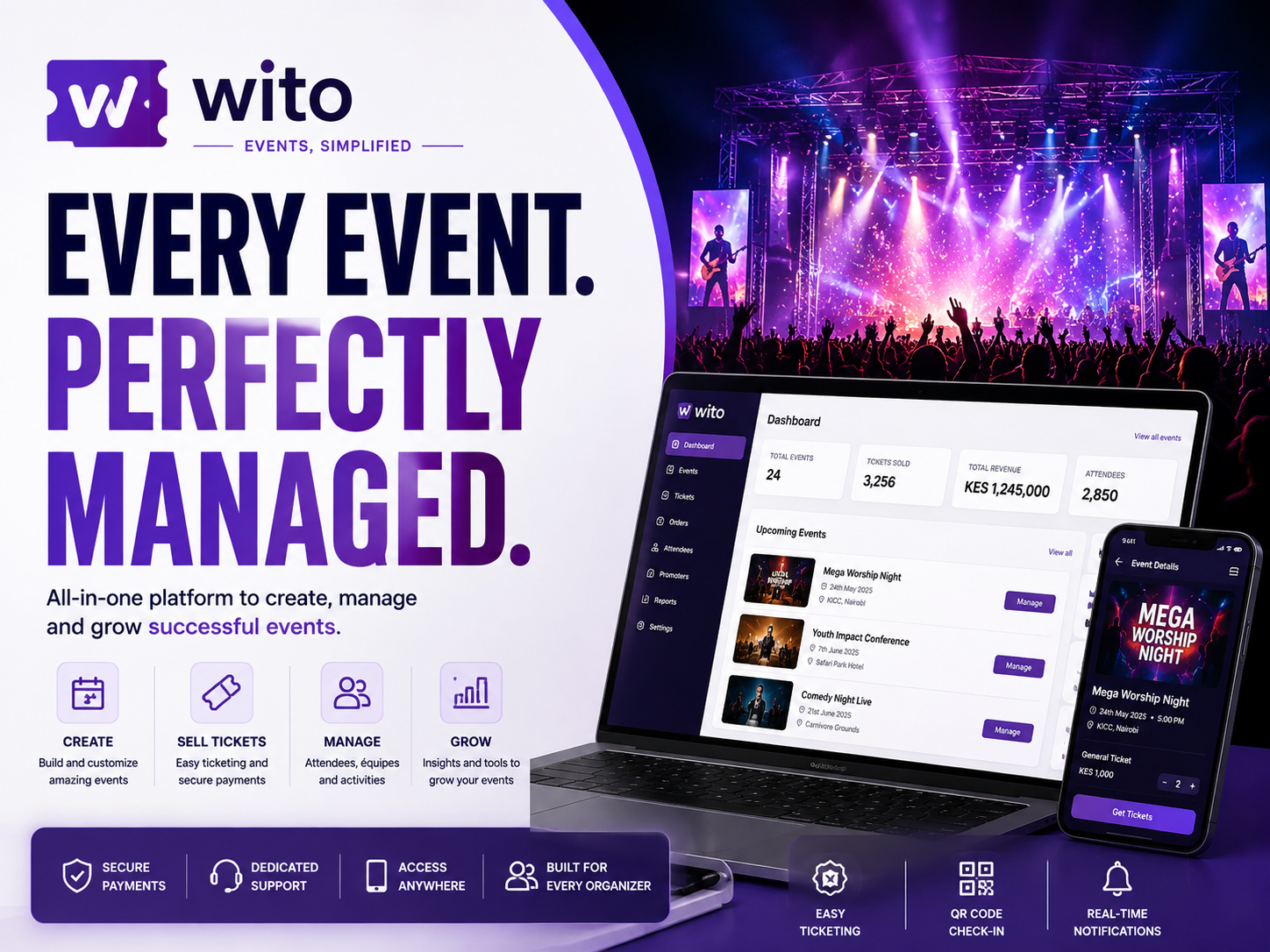
For organizations looking for a comprehensive solution, Wito provides an integrated platform that combines online event creation, customizable registration forms, flexible ticket categories, secure payment processing, QR code ticket generation, attendee management, reporting, and event communication in one centralized system. This allows organizers to manage every stage of the event lifecycle while maintaining complete control over branding and attendee experiences.
Conclusion
Every successful event has unique goals, audiences, and operational requirements. Choosing customizable event ticketing software allows organizers to build registration processes, ticket categories, payment workflows, and attendee experiences that reflect the specific needs of each event rather than adapting to the limitations of generic software.
Whether organizing a business conference, university graduation, church convention, charity fundraiser, music festival, exhibition, networking event, or government forum, a customizable platform provides the flexibility needed to deliver professional, secure, and memorable events.
Organizations across Kenya and beyond are increasingly recognizing the value of digital event management. By investing in a flexible solution such as Wito, they can improve efficiency, strengthen security, enhance attendee satisfaction, and build a solid foundation for future event growth.
Benefits for Different Stakeholders
Investing in customizable event ticketing software delivers value to every stakeholder involved in planning, managing, sponsoring, and attending an event. While many organizations initially adopt a ticketing platform to simplify online registrations, the long-term benefits extend much further. From improving operational efficiency and communication to strengthening security and generating actionable insights, a customizable platform transforms how events are organized.
Unlike rigid ticketing systems that force organizers to adapt to predefined workflows, customizable event ticketing software allows every stakeholder to enjoy an experience tailored to their specific needs. This flexibility is particularly valuable for organizations that host different types of events throughout the year, as each event often requires unique registration forms, ticket categories, branding, payment methods, and attendee communication.
Whether the event is organized by a university, church, business, government agency, non-governmental organization, or event management company, a flexible ticketing solution creates a more efficient and professional experience for everyone involved.
Benefits for Event Organizers
Event organizers are responsible for coordinating every stage of an event, from planning and registration to check-in and post-event reporting. Managing these responsibilities manually can quickly become overwhelming, especially when multiple events are taking place simultaneously.
By implementing customizable event ticketing software, organizers gain access to tools that simplify complex workflows while reducing repetitive administrative tasks.
Some of the key benefits include:
- Creating unlimited events from one dashboard.
- Designing customized registration forms for different event types.
- Managing multiple ticket categories with different pricing structures.
- Tracking ticket sales in real time.
- Monitoring event capacity.
- Communicating with attendees automatically.
- Generating attendance reports.
- Managing staff permissions.
Instead of spending hours updating spreadsheets or manually confirming registrations, organizers can focus on delivering a memorable event experience.
A centralized dashboard also enables organizers to monitor registrations, payments, attendance, and event performance from anywhere with an internet connection.
Benefits for Event Attendees
Attendees expect registration to be fast, convenient, and secure. Complicated registration processes often discourage potential participants from completing ticket purchases.
Using customizable event ticketing software, attendees can complete registration within minutes using their smartphones, tablets, or computers.
Benefits for attendees include:
- Fast online registration.
- Secure online payments.
- Instant confirmation emails.
- Digital ticket delivery.
- Mobile ticket access.
- QR code event entry.
- Event reminders.
- Real-time event updates.
- Easy access to event schedules.
Because registration forms can be customized, attendees only provide information relevant to the event instead of completing unnecessarily long forms.
The result is a smoother registration experience that encourages higher participation rates.
Benefits for Businesses and Corporate Organizations
Businesses organize numerous events throughout the year, including:
- Product launches.
- Customer appreciation events.
- Annual conferences.
- Executive meetings.
- Staff training sessions.
- Business networking forums.
- Investor presentations.
- Industry exhibitions.
A flexible platform allows corporate event planners to customize registration processes according to the objectives of each event.
For example, a networking conference may require attendee job titles and industries, while a product launch may ask participants about product interests or purchasing intentions.
With customizable event ticketing software, businesses can also strengthen their brand by personalizing registration pages, confirmation emails, and digital tickets with company logos, colours, and messaging.
This creates a more consistent customer experience while reinforcing corporate identity.
Benefits for Educational Institutions
Universities, colleges, and schools organize hundreds of academic and extracurricular activities every year.
Examples include:
- Graduation ceremonies.
- Orientation programmes.
- Career fairs.
- Student elections.
- Sports tournaments.
- Research conferences.
- Alumni reunions.
- Innovation competitions.
- Guest lectures.
- Leadership workshops.
Educational institutions benefit from customizable event ticketing software because each event requires different registration information.
For example:
- Graduation events may require student admission numbers.
- Conferences may collect research interests.
- Career fairs may request CV uploads.
- Alumni events may capture graduation years.
- Sports competitions may require team information.
The flexibility to customize forms ensures organizers collect accurate information without making registration unnecessarily complicated.
Benefits for Churches and Religious Organizations
Churches frequently organize:
- Annual conferences.
- Youth conventions.
- Leadership seminars.
- Worship concerts.
- Prayer retreats.
- Mission conferences.
- Fundraising dinners.
- Community outreach programmes.
Many churches rely heavily on volunteers, making efficient administration particularly important.
Using customizable event ticketing software, churches can customize registration forms to collect parish information, ministry involvement, accommodation preferences, dietary requirements, volunteer availability, or transportation needs.
Organizers can also automate communication before and after events, reducing administrative workload while improving attendee engagement.
Benefits for Government Institutions
Government agencies regularly organize public participation forums, stakeholder consultations, policy workshops, exhibitions, and official conferences.
These events often require secure registration, attendance verification, and accurate reporting.
A customizable platform enables government institutions to configure participant categories, registration requirements, security permissions, and reporting structures according to each programme.
This improves accountability while simplifying event administration.
Benefits for NGOs and Non-Profit Organizations
Non-governmental organizations frequently host:
- Fundraising events.
- Charity walks.
- Community training programmes.
- Awareness campaigns.
- Volunteer workshops.
- Donor conferences.
- Capacity-building seminars.
Because funding accountability is critical, NGOs benefit from the reporting capabilities offered by customizable event ticketing software.
Organizers can monitor registrations, attendance, donations, and financial performance through real-time dashboards while maintaining accurate records for donors and stakeholders.
Improving Efficiency Through Automation
Automation is one of the most valuable capabilities provided by customizable event ticketing software. Tasks that once required several employees can now be completed automatically within seconds.
This allows organizations to reduce administrative costs while improving consistency and accuracy.
Automated Event Creation
Templates allow organizers to create recurring events quickly without rebuilding every registration page from scratch.
Organizations hosting monthly seminars or annual conferences save considerable time through reusable configurations.
Automatic Ticket Generation
After successful registration, the platform instantly generates a personalized digital ticket containing a unique QR code.
There is no need for staff to manually issue tickets or send confirmation emails.
Attendees receive everything immediately, improving customer satisfaction.
Automated Email Communication
Modern platforms automatically send:
- Registration confirmations.
- Payment receipts.
- Reminder emails.
- Venue directions.
- Programme updates.
- Speaker announcements.
- Event changes.
- Thank-you messages.
These automated communications ensure attendees remain informed throughout the event lifecycle.
Automated Capacity Management
Managing venue capacity manually increases the risk of overselling tickets.
Using customizable event ticketing software, organizers can configure maximum attendance limits for each ticket category.
Once capacity is reached, registrations automatically close or attendees are added to a waiting list.
This improves safety while preventing overcrowding.
Real-Time Dashboard Monitoring
Automation also enables organizers to monitor:
- Registrations.
- Ticket sales.
- Revenue.
- Attendance.
- Check-in progress.
- Payment status.
- Marketing performance.
These live insights help organizers respond quickly to changing circumstances before problems develop.
Financial Automation
The platform automatically calculates:
- Total revenue.
- Discounts.
- Taxes.
- Complimentary tickets.
- Refunds.
- Outstanding payments.
Finance teams spend less time performing manual calculations while improving reporting accuracy.
Compliance, Security and Risk Management
Security has become one of the most important considerations when selecting an event management platform. Every event collects valuable information, including attendee names, contact details, payment records, ticket information, and attendance history. Protecting this information is essential for maintaining trust and ensuring smooth event operations. This is one of the reasons many organizations are investing in customizable event ticketing software, as modern platforms provide advanced security features that are difficult to achieve with manual registration systems.
Whether the event is a university graduation, corporate conference, church convention, government forum, charity fundraiser, or international exhibition, organizers must ensure that attendee information remains confidential and that only authorized participants gain access to the venue.
A professional ticketing platform helps organizations minimize risks while improving operational efficiency through multiple layers of protection.
Secure Payment Processing
Financial transactions must be handled using secure and trusted payment gateways. Every payment should be encrypted from the moment an attendee enters their payment details until the transaction is successfully completed.
Modern customizable event ticketing software supports secure integrations with trusted payment providers, reducing the risk of fraud while giving attendees confidence to purchase tickets online.
For organizations operating in Kenya, supporting trusted payment options such as M-Pesa alongside traditional card payments creates additional convenience while maintaining high security standards.
Unique QR Code Validation
One of the greatest advantages of digital ticketing is the use of unique QR codes.
Each ticket generated through customizable event ticketing software contains a unique identification code that can only be scanned once.
This prevents several common problems, including:
- Duplicate ticket usage
- Counterfeit tickets
- Unauthorized entry
- Manual attendance errors
- Ticket sharing beyond permitted limits
When attendees arrive at the venue, event staff simply scan the QR code using a smartphone or scanning device. Verification takes only a few seconds, significantly reducing queues while improving security.
Role-Based User Permissions
Not every staff member should have access to every part of the system.
A customizable platform allows administrators to assign different permission levels depending on individual responsibilities.
Examples include:
- System Administrator
- Event Manager
- Finance Officer
- Registration Officer
- Marketing Coordinator
- Check-In Staff
- Volunteer Coordinator
- Security Personnel
Role-based permissions reduce operational risks by ensuring users only access the information necessary for their responsibilities.
Secure Cloud Storage
Unlike paper registration forms that can easily be misplaced or damaged, cloud-based systems securely store attendee information while maintaining regular backups.
Organizations using customizable event ticketing software benefit from reliable cloud infrastructure that protects event records against hardware failures, accidental deletion, or local computer damage.
Cloud storage also makes collaboration easier because authorized team members can access event information from different locations whenever necessary.
Audit Trails
Professional event platforms maintain detailed activity logs showing important actions performed within the system.
Audit trails typically record:
- Ticket creation
- Registration updates
- Payment confirmations
- Refund approvals
- User logins
- Permission changes
- Event edits
These records improve accountability while making it easier to investigate operational issues if they occur.
Why Wito Is the Ideal Solution
Organizations today require much more than an application that simply sells tickets. They need a complete event management ecosystem capable of supporting every stage of the attendee journey.
Wito has been developed to meet these needs by providing a comprehensive platform that combines flexibility, automation, security, and ease of use.
Unlike many traditional ticketing systems that provide limited customization, Wito enables organizations to configure their events according to their own operational requirements.
Whether you are organizing:
- Corporate conferences
- Business seminars
- Church conventions
- University graduations
- Alumni events
- Charity fundraisers
- Music concerts
- Cultural festivals
- Government forums
- Trade exhibitions
- Sporting competitions
- Networking events
Wito provides the flexibility required to deliver professional event experiences.
Key capabilities include:
- Unlimited event creation
- Fully customizable registration forms
- Flexible ticket categories
- QR code ticket generation
- Secure online payments
- Mobile-friendly registration
- Real-time dashboards
- Digital attendee management
- Automated communication
- Attendance reporting
- Event analytics
- Custom branding
Because everything is managed from one centralized platform, organizers eliminate the need to combine multiple disconnected applications.
This not only improves efficiency but also reduces administrative costs while enhancing the attendee experience.
For organizations across Kenya, Wito supports the growing demand for professional digital event management while providing the flexibility required for different industries and event types.
Future Trends in Event Ticketing
Technology continues changing how events are planned, promoted, and managed.
The future of customizable event ticketing software will be shaped by several important developments that improve efficiency while creating more engaging attendee experiences.
Artificial Intelligence
Artificial intelligence is expected to automate many event management activities, including:
- Predicting attendance
- Recommending ticket prices
- Personalizing attendee communication
- Answering frequently asked questions
- Identifying registration trends
- Improving marketing campaigns
These capabilities will help organizers make more informed decisions while reducing manual work.
Hybrid Event Management
Many organizations now combine physical attendance with virtual participation.
Future ticketing platforms will provide seamless management of both audiences from one dashboard, ensuring consistent registration, communication, and reporting regardless of attendance method.
Contactless Event Experiences
Digital tickets, QR code scanning, and mobile registration have already reduced dependence on printed tickets.
Future developments will continue supporting completely contactless event experiences that improve convenience, security, and operational efficiency.
Advanced Analytics
Data-driven decision-making will become even more important.
Future reporting tools will provide deeper insights into attendee behaviour, purchasing trends, marketing performance, networking activity, and overall return on investment.
These insights will enable organizers to continuously improve future events.
Mobile-First Event Management
Smartphones have become the primary device used for registration and ticket purchases.
Future customizable event ticketing software platforms will continue enhancing mobile functionality by supporting digital wallets, live notifications, networking features, interactive event schedules, and attendee engagement tools.
Getting Started
Selecting the right customizable event ticketing software begins with understanding the specific objectives of your organization.
Before choosing a platform, ask important questions such as:
- What types of events do we organize?
- How many attendees do we expect each year?
- Which payment methods should be supported?
- Do we need custom registration forms?
- Will we require multiple ticket categories?
- How important is mobile registration?
- What reports do we need after every event?
- Will different departments manage separate events?
- How much customization do we require?
- How will the platform support future growth?
Answering these questions helps identify a solution capable of meeting both current and long-term requirements.
Organizations should prioritize software that is:
- Easy to use
- Secure
- Highly customizable
- Scalable
- Mobile friendly
- Reliable
- Well supported
- Suitable for future expansion
Choosing a platform with strong customization capabilities ensures that future events can continue evolving without requiring organizations to change systems.
Final Thoughts
Every successful event is different. Conferences, exhibitions, graduations, concerts, fundraising dinners, church conventions, networking forums, and university programmes all require unique registration processes and attendee experiences. Investing in customizable event ticketing software allows organizations to build flexible workflows that match their specific operational requirements while improving efficiency, security, and attendee satisfaction.
For organizations in Kenya and across the world, digital transformation continues reshaping event management. A modern platform such as Wito provides the tools needed to simplify event planning, automate repetitive tasks, strengthen security, improve reporting, and deliver memorable experiences from registration through post-event analysis.
Organizations that adopt flexible event management technology today will be better prepared to host larger, more engaging, and more successful events in the future.
customizable event ticketing software
customizable event ticketing software
customizable event ticketing software
customizable event ticketing software
customizable event ticketing software
customizable event ticketing software
customizable event ticketing software
customizable event ticketing software
customizable event ticketing software
customizable event ticketing software
customizable event ticketing software
customizable event ticketing software