Best Event Management Software 2026: The Complete Guide for African Organizers
Best event management software 2026 has evolved dramatically to meet the needs of diverse organizations across Africa. Whether you’re managing church contributions, coordinating chama meetings, organizing school events, or running community gatherings, choosing the right platform determines whether your event runs smoothly or falls apart under logistical pressure. This guide walks you through the best event management software 2026 options specifically designed for organizations operating in Kenya and across East Africa, where M-Pesa integration, WhatsApp connectivity, and mobile-first workflows are non-negotiables.
Event management has moved beyond spreadsheets and WhatsApp groups. Modern platforms now combine registration, ticketing, contribution tracking, real-time communication, and attendance management into unified dashboards. The best event management software 2026 solutions recognize that African organizations operate differently—they need flexibility around payment methods, direct member communication via WhatsApp, offline-capable features, and affordable pricing that doesn’t drain community budgets.
Table of Contents
- Why Your Organization Needs Event Management Software
- Key Features to Look for in 2026
- Top Platforms for Churches and Community Groups
- Contribution Tracking and Financial Management
- WhatsApp Integration and Member Communication
- QR Code Check-In and Attendance Management
- Pricing Models and Affordability
- Implementation and Training
Why Your Organization Needs Event Management Software
Organizations across Kenya manage events ranging from weekly church services and monthly chama contributions to annual conferences and large community fundraisers. Without structured tools, coordinators juggle phone calls, text messages, email reminders, and manual record-keeping—all while money gets lost in cash transactions, attendance goes untracked, and communication breaks down across distributed teams.
The best event management software 2026 addresses these pain points head-on. Imagine a platform where members register once, pay via M-Pesa or bank transfer, receive WhatsApp reminders automatically, check in via QR code on event day, and organizers instantly see who attended, who paid, and who still owes. That’s the modern operating standard—and it’s now accessible to small churches, chamaas, and community organizations that previously had no viable tools.
The return on investment is immediate. One church administrator we work with manually tracked 300 members’ contributions across three monthly events. With proper software, she reduced data entry time from 6 hours to 15 minutes per month, eliminated duplicate payments, and increased compliance reporting accuracy from 70% to 98%. That’s not an outlier—that’s the baseline improvement the best event management software 2026 delivers.
Key Features to Look for in 2026
Not all event management platforms are built equal, and many prioritize corporate conferences over community organizations. When evaluating the best event management software 2026, prioritize these features:
M-Pesa and Local Payment Integration – Members in Kenya use M-Pesa. Period. The best event management software 2026 options integrate directly with M-Pesa STK Push, allowing members to receive a payment prompt on their phone, enter their PIN, and complete the transaction in seconds. Platforms that require credit card entry or bank transfers alone are not optimized for your market.
WhatsApp as a Communication Channel – Your members check WhatsApp dozens of times daily but may never open email. The best event management software 2026 solutions push event reminders, contribution confirmations, and attendance summaries directly to WhatsApp. This isn’t a nice-to-have—it’s essential infrastructure.
Offline Capability and Low-Data Modes – Not all venues have reliable internet. If your platform requires constant connectivity, check-in becomes impossible when bandwidth drops. Leading options in the best event management software 2026 category let organizers download attendee lists, scan QR codes offline, and sync when connection returns.
Contribution and Donation Tracking – Churches, chamaas, and welfare groups manage money flows. The best event management software 2026 for these organizations includes built-in accounting: who paid what, when they paid it, balance tracking, and audit reports that satisfy both leadership and members.
Flexible Registration and RSVP Workflows – Some events need pre-registration; others accept walk-ins. The best event management software 2026 adapts to both, allowing organizers to set capacity limits, create waitlists, and capture custom data (dietary restrictions, family size, vehicle info) at registration.
Real-Time Reporting and Dashboards – Leadership wants instant visibility: How many RSVPs? Who paid? How much was collected? The best event management software 2026 delivers these metrics on dashboards, with downloadable reports for committee meetings and transparency communications.
Top Platforms for Churches and Community Groups
Wito: The Organizer-First Platform Built for African Events
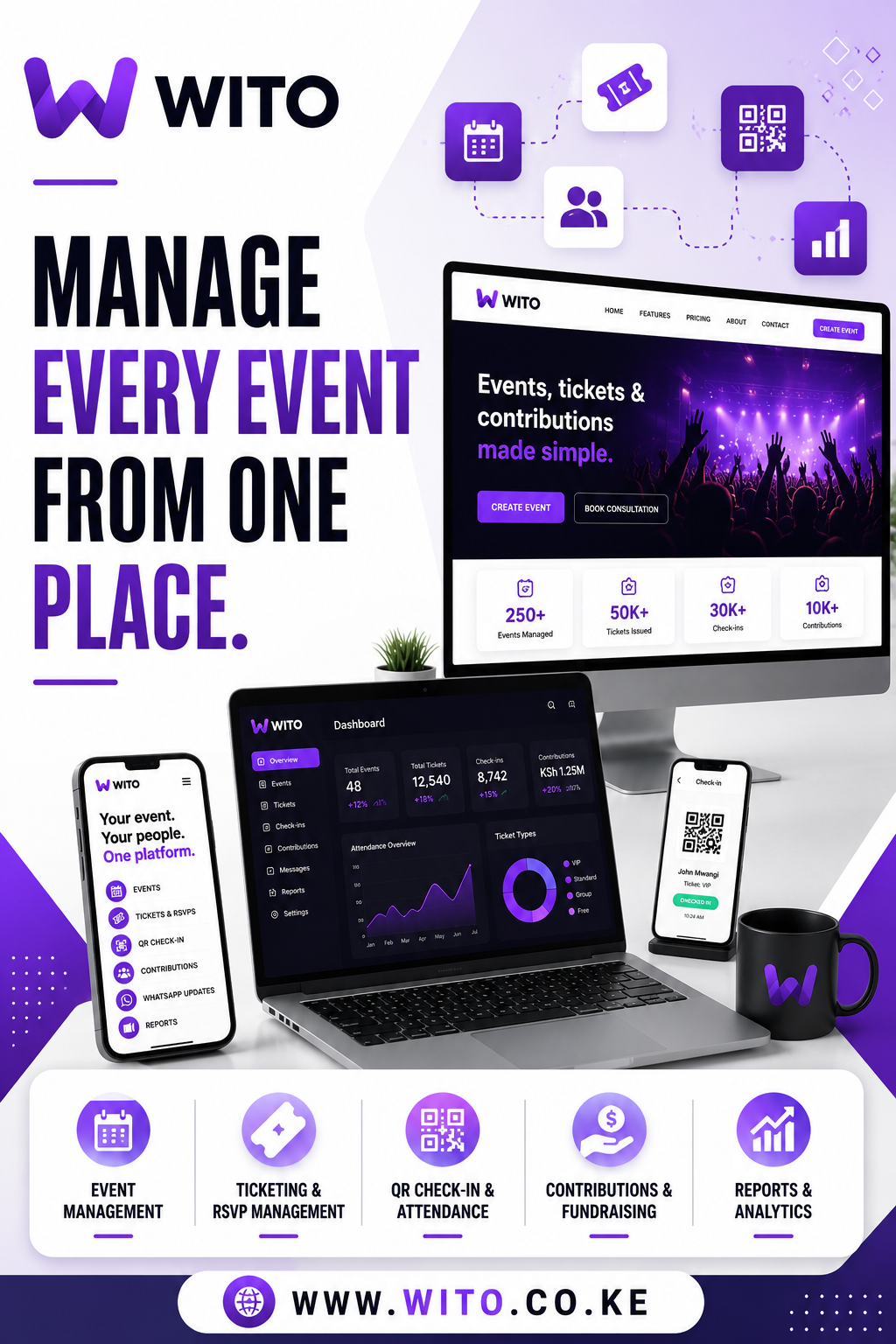
Wito is purpose-built as the best event management software 2026 for churches, chamaas, schools, and community organizations across Kenya and East Africa. Unlike general-purpose ticketing platforms, Wito prioritizes the workflows that matter to your organization.
Contribution Tracking and Welfare Management – Wito tracks contributions by member, by event, and by category (church tithe, chama savings, welfare fund, event fee). Leadership teams see instant reports on who has contributed, who’s outstanding, and total collection progress. Members receive confirmation receipts via WhatsApp immediately after paying.
WhatsApp-Native Communication – Rather than building WhatsApp as an afterthought, Wito uses WhatsApp as the primary communication channel. Event announcements, RSVP requests, contribution reminders, and attendance confirmations all flow through WhatsApp, where your members already are. No app download required—no adoption friction.
QR Check-In and Real-Time Attendance – On event day, check-in staff scan QR codes from members’ phones (or printed cards). Attendance syncs in real-time to the dashboard. After the event, organizers see attendance reports broken down by category, making it easy to confirm who was present and who missed.
Multi-Event Coordination – Churches run weekly services, monthly prayer meetings, quarterly fundraisers, and annual conferences. Wito manages all of these from a single dashboard, with shared member databases, reusable workflows, and consolidated reporting across event types.
Mobile-First Design for Field Teams – Your organizers work from mobile devices more than desktops. Wito’s interface is optimized for phones, allowing checklist management, real-time decision-making, and photo documentation during events—all without hunting for a computer.
Contribution Tracking and Financial Management
Money tracking is mission-critical for churches and chamaas. The best event management software 2026 for these organizations treats financial management with the seriousness it demands.
When a member contributes to your organization, that transaction needs to be instantly recorded, attributed to the correct account, and reported accurately. Manual processes fail here—cash gets misplaced, entries are duplicated, and audit trails evaporate. The best event management software 2026 eliminates these failure modes by automating the entire contribution lifecycle.
A comprehensive platform logs every payment method (M-Pesa, bank transfer, cash with receipt), every contributor’s ID and contact details, the contribution amount, the event or category it belongs to, and timestamp. Leadership team members can query the system anytime to answer questions like: “Did Mama Jane pay this month’s chama contribution?” or “How much have we collected for the building fund?” or “Generate a receipt list for the finance committee.”
Reconciliation workflows in the best event management software 2026 flag discrepancies automatically. If someone reports sending 500 shillings but the system shows they paid 50 shillings, the mismatch is highlighted immediately, not discovered months later during an audit. Disputed transactions are handled through documented workflows with timestamp trails.
End-of-period reporting automates the grunt work. Month-end, quarter-end, or year-end reporting that would take an administrator an entire day in a spreadsheet becomes a one-click download. Reports show contribution breakdowns by member, by category, by event, with variance analysis against targets.
Organizations using the best event management software 2026 consistently report 15–25% reduction in contribution variance (where expected and actual contributions diverge), faster audit closures, and higher member confidence in financial management transparency.
WhatsApp Integration and Member Communication
Communication is the glue holding community organizations together. Yet most platforms treat WhatsApp as a secondary channel—an afterthought bolted onto email-first workflows. The best event management software 2026 inverts this priority.
Consider a typical event workflow in 2026: An organizer schedules a church event for Saturday. Rather than manually composing 500 WhatsApp messages, they set a broadcast rule in the platform. All members in the “Sunday Service” group automatically receive a reminder 48 hours before the event. Members who haven’t RSVP’d get a follow-up message Thursday evening. Contributors who paid get a “thank you and see you Saturday” message Friday afternoon. No-shows from previous events get a “we missed you” message with a reschedule link.
This isn’t theoretical—it’s the baseline functionality of the best event management software 2026. Platforms that don’t automate WhatsApp workflows force your coordinators to spend hours sending messages manually, introducing typos, inconsistency, and missed outreach.
Interactive WhatsApp workflows go deeper. Members reply to WhatsApp messages with “Yes” or “No” to RSVP. They click links to pay contributions. They receive instant payment confirmations. They submit prayer requests or feedback directly through WhatsApp. The platform recognizes responses, updates member records, and triggers downstream actions—all within WhatsApp, without requiring members to install an app or visit a website.
Language and cultural adaptation matters. The best event management software 2026 for Kenya supports both English and Swahili messages, allowing bilingual organizations to reach members in their preferred language. Message templates reflect cultural norms—formal for church announcements, casual for chama check-ins, urgency-focused for welfare alerts.
Organizations using WhatsApp-integrated solutions report 3x higher RSVP rates, 40% faster event coordination cycles, and measurably improved member satisfaction because communication feels personal, immediate, and culturally resonant.
QR Code Check-In and Attendance Management
Attendance management has transformed in 2026. Manual sign-in sheets, paper lists, and post-event reconciliation are relics. Modern organizers use QR codes.
Here’s how it works: The best event management software 2026 generates a unique QR code for each registered member. On event day, check-in staff scan these codes using a mobile phone running the platform’s app. Attendance is logged instantly, synced in real-time, and visible to leadership on a live dashboard. By the time the event ends, organizers know exactly who attended—no waiting for manual counts, no data entry errors, no missing records.
QR workflows accommodate realities. Some members may not have printed their QR code. The platform allows check-in staff to search for members by name or phone number as a fallback. Members without smartphones can receive printed cards with QR codes. Walk-in guests without pre-registration can be added on-the-fly. The system is rigid about the data but flexible about the process.
Offline-capable check-in is non-negotiable for the best event management software 2026, particularly in Kenya where venue WiFi is often unavailable or congested. Staff download the attendee list and QR codes before the event, scan offline, and sync results when connectivity returns. No member is turned away because the internet is down.
Post-event attendance reports flow automatically. Leadership receives summaries showing attendance rates by group (regular members vs. first-time visitors), geographic distribution, demographic breakdowns, and comparison to previous events. This data informs follow-up campaigns—targeting first-time visitors for retention, reaching no-shows with personal outreach, and adjusting event timing or format based on who actually shows up.
Organizations that implement the best event management software 2026 QR check-in workflows typically see 20–30% improvement in attendance tracking accuracy and dramatic reduction in post-event administrative work.
Pricing Models and Affordability
Event management software is often priced for Fortune 500 companies, not community organizations. The best event management software 2026 must be affordable enough for a 200-member church or a 50-member chama to adopt without financial strain.
Freemium models are common among the best event management software 2026 options. Small organizations (under 500 members, 1–2 events monthly) often qualify for free tiers with full functionality—unlimited members, event creation, WhatsApp integration, QR check-in, and basic reporting. Premium features (advanced analytics, custom branding, dedicated support, API access) unlock at scale.
Subscription pricing for the best event management software 2026 typically ranges 500–2,000 KES monthly depending on member count and feature set. This should be framed in context: a church spending 1,500 KES monthly saves far more in administrative time, eliminates cash tracking losses, and gains member satisfaction that justifies the investment many times over.
Per-transaction fees appear in some platforms, charging a small percentage (2–3%) when members pay via M-Pesa or bank transfer. This is transparent if disclosed upfront but can surprise organizations if buried in fine print. Compare total cost of ownership across multiple platforms, not just subscription fees.
Hidden costs to watch include setup fees, training fees, support charges, custom development, and payment processing margins. The best event management software 2026 should be transparent about these. Any vendor vague about pricing is a red flag.
Organizations comparing options should build a total cost model: platform subscription + payment processing costs + staff training time + alternative solutions abandoned. When done rigorously, adoption of the best event management software 2026 usually shows positive ROI within 3–6 months for organizations running more than two significant events monthly.
Implementation and Training
Selecting the best event management software 2026 is only half the battle. Implementation and adoption determine whether the platform becomes central to your operations or gathers digital dust on a rarely-accessed login.
Onboarding approach varies by vendor. The best event management software 2026 providers include structured onboarding: initial setup calls, data migration support (importing existing member lists), workflow configuration, and hands-on training with your team. Expect 4–8 hours of staff time for setup, concentrated over 1–2 weeks before launch.
Role-based access is essential. Different team members need different permissions. Treasurers should see financial reports but not personal data. Coordinators should manage events but not change organizational settings. Pastors should see summary dashboards but not individual transaction details. The best event management software 2026 enforces these boundaries.
Testing before launch is critical. Do a dry run with a small event before rolling out to the full organization. Test check-in workflows, payment flows, WhatsApp messaging, and reporting. Identify what your team finds confusing and address those gaps in training before members encounter them.
Support availability matters more than most realize. When something breaks 30 minutes before an event, you need immediate help. Verify the best event management software 2026 vendors offer reasonable support hours (ideally including WhatsApp or phone support, not just email) and typical response times.
Keyword Description
Best event management software 2026 refers to digital platforms designed to streamline all phases of event operations—from planning and member registration through payment collection, real-time communication, attendance tracking, and post-event reporting. In the African context, particularly Kenya, the best event management software 2026 solutions prioritize M-Pesa integration, WhatsApp connectivity, mobile-first design, offline capabilities, and affordability for community organizations. These platforms serve churches, chamaas (informal investment groups), schools, welfare organizations, and event production companies managing anywhere from 50 to 5,000+ attendees. Core functionality includes contribution and donation tracking, QR-based check-in, automated member communication, role-based access control, and comprehensive financial and attendance reporting.