Stage Production Services: A Complete Guide to Professional Event Stage Production

stage production services

Stage Production Services are an essential part of creating professional, engaging, and memorable events. Whether you are organizing a corporate conference, music concert, wedding, product launch, church event, awards ceremony, school function, exhibition, or large outdoor gathering, the stage often becomes the central point where the most important moments happen.

A well-designed stage does more than provide a platform for speakers and performers. It creates the visual foundation of an event and supports lighting, sound, LED screens, presentations, branding, entertainment, and audience engagement.

For organizations planning professional events in Kenya, choosing the right production partner can make a significant difference. A reliable team understands how to combine stage design, technical equipment, safety, lighting, audio, video, and on-site management to create a complete event environment.

Professional Stage Production Services can transform an ordinary venue into a carefully designed event space. The production team can develop a stage that matches the event’s purpose, audience, venue, theme, and brand identity.

Modern event production also goes beyond physical staging. Today’s events frequently require LED displays, cameras, live streaming, professional sound systems, intelligent lighting, presentation screens, and technical crews. All these elements need to work together.

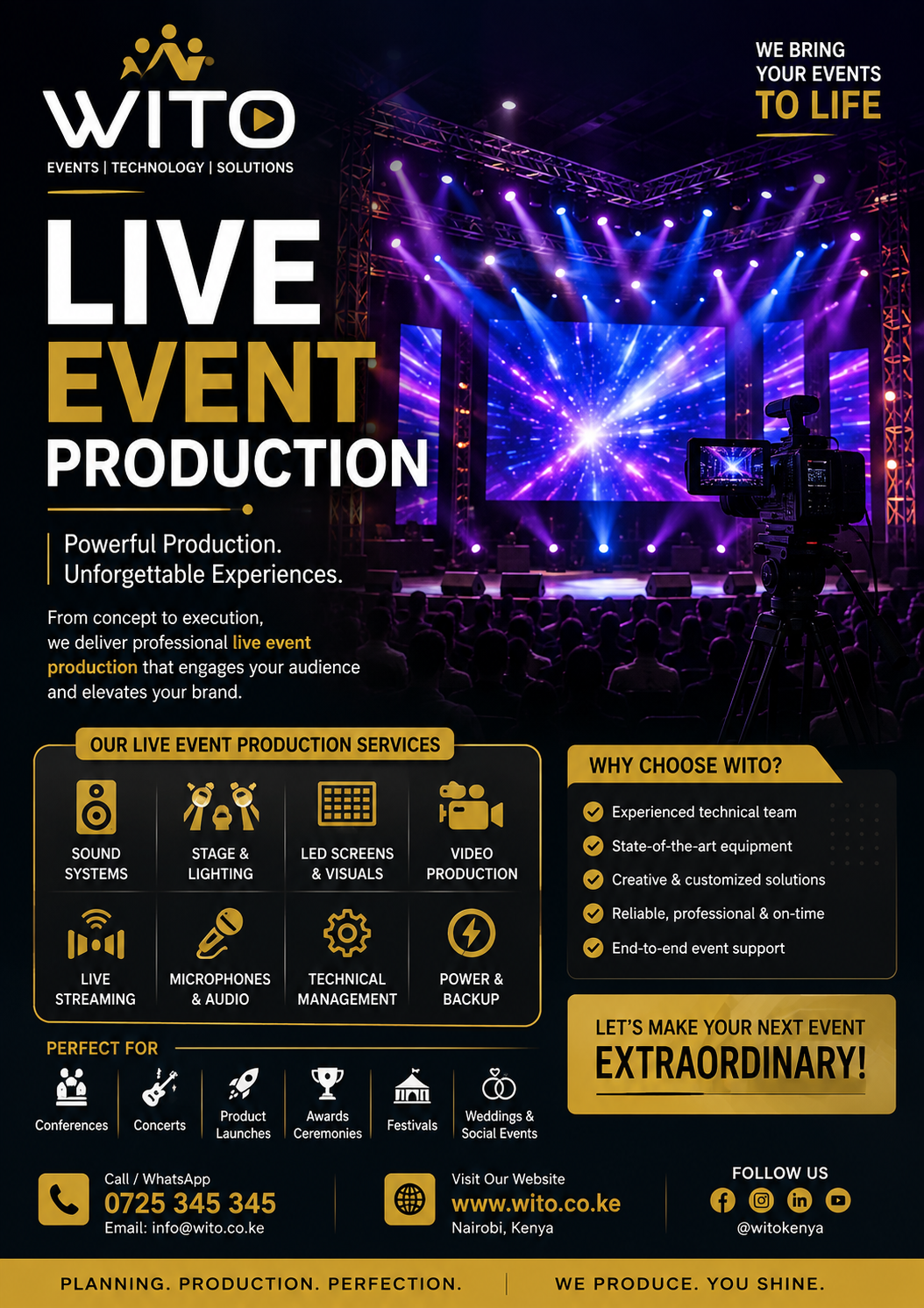
Wito.co.ke provides event production support that includes live and event production, streaming, cameras, screens, recordings, and event operations.

Table of Contents

What Are Stage Production Services?

Stage Production Services refer to the professional planning, design, installation, operation, and management of the technical and physical elements used to create an event stage.

These services can include:

  • Stage design
  • Stage construction
  • Stage platforms
  • Backdrops
  • LED screens
  • Video walls
  • Stage lighting
  • Sound systems
  • Microphones
  • Presentation systems
  • Stage branding
  • Truss structures
  • Technical crew
  • Event power management
  • Stage management

The exact requirements depend on the type and scale of the event.

A small corporate meeting may require a simple raised platform, backdrop, presentation screen, microphones, and basic lighting.

A large concert may require a much more complex structure involving multiple LED screens, concert lighting, line-array sound systems, stage monitors, rigging, power distribution, and a large technical crew.

This is why professional Stage Production Services should begin with understanding the event rather than simply supplying equipment.

Why Stage Production Matters

The stage is usually one of the first things audiences notice when entering an event venue.

A professionally designed stage can immediately communicate:

  • Quality
  • Professionalism
  • Brand identity
  • Event theme
  • Organization
  • Creativity
  • Attention to detail

For corporate events, the stage can reinforce a company’s brand.

For concerts, it can create an exciting environment for performers.

For weddings, it can provide an elegant focal point for the couple and guests.

For conferences, it gives speakers a professional platform.

For product launches, it can create a dramatic environment for revealing new products.

Professional Stage Production Services help ensure that the stage supports the event rather than becoming a technical or visual distraction.

Types of Events That Need Stage Production

Different events require different approaches to staging.

Corporate Events

Companies use stages for:

  • Annual meetings
  • Staff events
  • Conferences
  • Seminars
  • Awards ceremonies
  • Product launches
  • Executive presentations
  • Company celebrations

Corporate stages often incorporate company branding, presentation screens, LED displays, professional lighting, and presentation systems.

Conferences

Conference stages must support multiple speakers and presentations.

A typical conference stage may include:

  • Lectern
  • Speaker chairs
  • LED screen
  • Confidence monitor
  • Stage lighting
  • Presentation system
  • Microphones
  • Branding elements

Professional Stage Production Services can help conference organizers create a stage that remains functional throughout multiple sessions.

Concerts

Concerts require specialized staging because performers need sufficient space for instruments, dancers, equipment, and technical systems.

Concert stages may include:

  • Main performance platform
  • Extended stage
  • LED walls
  • Side screens
  • Trussing
  • Moving lights
  • Stage monitors
  • Line-array speakers
  • Backline areas

The production design must consider both performers and the audience.

Weddings

Wedding staging is often focused on aesthetics.

Popular elements include:

  • Decorative backdrops
  • Floral arrangements
  • LED screens
  • Elegant lighting
  • Couple’s seating
  • Dance floors
  • Custom stage designs
  • Monograms

Professional staging can turn a reception area into a visually impressive environment.

Church and Religious Events

Religious events can also require professional staging.

Examples include:

  • Worship services
  • Gospel concerts
  • Conferences
  • Youth events
  • Fundraising events
  • Religious celebrations

Stage systems can include sound, LED displays, lighting, cameras, and streaming equipment.

Product Launches

A product launch stage needs to attract attention and support presentations.

Production teams can incorporate:

  • Branded backdrops
  • LED screens
  • Product display areas
  • Presentation screens
  • Lighting effects
  • Video content
  • Demonstration areas

A carefully planned stage can make the product reveal more memorable.

Stage Design and Planning

Successful Stage Production Services begin with proper design and planning.

Before construction begins, the production team should understand:

  • Venue dimensions
  • Audience size
  • Event type
  • Stage requirements
  • Speaker requirements
  • Performer requirements
  • Screen requirements
  • Lighting requirements
  • Sound requirements
  • Branding requirements
  • Budget

Venue measurements are particularly important.

The production team needs to determine the available stage area, ceiling height, audience sightlines, access points, power availability, and equipment positioning.

Custom Stage Design

Not every event needs a standard stage.

Custom designs can be created to reflect a specific event concept.

Examples include:

  • Circular stages
  • T-shaped stages
  • Extended runways
  • Multi-level stages
  • Curved stages
  • Branded stages
  • Modular stages

For fashion shows, a runway can extend into the audience.

For concerts, an extended stage can bring performers closer to attendees.

For corporate events, a wide stage can accommodate several speakers.

Professional Stage Production Services allow the stage design to be adapted to the event’s objectives.

Stage Size and Audience Capacity

Stage dimensions should be appropriate for the venue and audience.

A stage that is too small may create technical and movement problems.

A stage that is unnecessarily large can consume valuable venue space and increase production costs.

The production team should consider:

  • Number of people on stage
  • Number of performers
  • Equipment
  • Screen size
  • Camera positions
  • Audience distance
  • Speaker movement
  • Event activities

Audience sightlines should also be considered.

Everyone should have a reasonable view of speakers, performers, presentations, and screens.

Stage Platforms

Stage platforms create the physical foundation of the stage.

They can be designed at different heights depending on the event.

Common stage platform applications include:

  • Speaker stages
  • Concert stages
  • Wedding stages
  • Exhibition platforms
  • Product display platforms
  • Fashion runways

Platforms must be properly assembled and secured.

Safety should always be prioritized during installation.

Stage Backdrops

Backdrops help establish the visual identity of an event.

A backdrop can display:

  • Event name
  • Company logo
  • Sponsor logos
  • Event theme
  • Campaign message
  • Product branding

Backdrops can be printed, constructed, illuminated, or displayed using LED technology.

A well-designed backdrop also provides an effective background for event photography and video.

LED Screens and Video Walls

Modern events increasingly use LED displays.

LED screens can display:

  • Presentations
  • Videos
  • Logos
  • Animations
  • Live camera feeds
  • Sponsor advertisements
  • Event graphics
  • Social media content

Large LED displays can improve visibility for audiences sitting far from the stage.

Professional Stage Production Services can integrate LED screens into the stage design so that the technology becomes part of the overall visual experience.

Stage Lighting

Lighting plays a major role in event production.

Different lights can be used for different purposes.

These include:

  • Spotlights
  • LED PAR lights
  • Moving heads
  • Wash lights
  • Profile lights
  • Uplighting
  • Follow spots
  • Decorative lighting

Lighting can highlight speakers, performers, products, and important areas of the stage.

It can also create different moods throughout an event.

Conference Stage Lighting

Conference lighting should make speakers clearly visible to both physical and online audiences.

The production team should consider:

  • Speaker position
  • Camera position
  • Screen brightness
  • Stage layout
  • Audience visibility

Too little lighting can make speakers difficult to see.

Excessive lighting can affect cameras and LED screens.

Professional lighting technicians balance these factors during setup.

Concert Stage Lighting

Concert lighting is more dynamic.

Lighting designers may use moving lights, color changes, beams, strobes, and other effects to complement musical performances.

The lighting should follow the energy and structure of the performance while maintaining visibility and safety.

Large concerts may require dedicated lighting operators who work closely with performers and production directors.

Professional Stage Sound

Stage production and sound are closely connected.

The audience needs to hear speakers and performers clearly.

Professional sound systems may include:

  • Main speakers
  • Subwoofers
  • Stage monitors
  • Wireless microphones
  • Digital mixers
  • Audio processors
  • Amplifiers
  • Microphone stands

The sound system should be designed according to the venue and audience size.

Microphone Solutions

Different speakers and performers may require different microphone types.

Options include:

  • Handheld microphones
  • Lavalier microphones
  • Headset microphones
  • Gooseneck microphones
  • Wireless microphones
  • Boundary microphones

Conference speakers often use wireless or lapel microphones.

Performers may require handheld wireless microphones.

Panel discussions may use individual microphones for each participant.

Stage Monitors

Stage monitors allow performers and speakers to hear audio from the production system.

They are particularly important during concerts and live performances.

Stage monitors can provide:

  • Vocal monitoring
  • Instrument monitoring
  • Presentation audio
  • Communication cues

The monitor mix should be adjusted according to the needs of performers and presenters.

Technical Crew

Professional Stage Production Services require an experienced technical team.

Depending on the event, the crew may include:

  • Production manager
  • Stage manager
  • Audio engineer
  • Lighting technician
  • Video technician
  • Camera operators
  • LED screen operator
  • Rigging technicians
  • Stagehands

Each person has a specific responsibility.

The production manager coordinates the entire technical operation.

The stage manager controls activity on and around the stage.

The audio engineer manages sound.

The lighting technician operates stage lighting.

Video technicians manage screens and visual content.

Stage Management

Stage management helps keep an event running according to schedule.

The stage manager may coordinate:

  • Speaker entrances
  • Performer entrances
  • Presentations
  • Microphone changes
  • Stage transitions
  • Video playback
  • Lighting cues
  • Program timing

This becomes especially important during conferences, concerts, award ceremonies, and large corporate events.

Stage Branding

Branding can turn a standard stage into a strong marketing asset.

Companies can incorporate their identity through:

  • Logos
  • Brand colors
  • Digital graphics
  • Printed backdrops
  • LED content
  • Branded podiums
  • Sponsor displays

Consistent branding across the stage, screens, presentations, and event materials creates a professional appearance.

Stage Safety

Safety should always be a priority.

Production teams should consider:

  • Stage stability
  • Equipment weight
  • Cable management
  • Electrical safety
  • Rigging
  • Access routes
  • Emergency exits
  • Audience distance
  • Weather conditions for outdoor events

Equipment should be installed by appropriately experienced personnel.

For outdoor events, additional considerations may include wind, rain, uneven ground, and weather changes.

Outdoor Stage Production

Outdoor events present different technical challenges.

Production teams need to consider:

  • Weather
  • Ground conditions
  • Power
  • Audience size
  • Stage covering
  • Equipment protection
  • Lighting
  • Sound coverage

Outdoor stages may require weather protection for equipment and performers.

Power distribution should also be carefully planned.

Indoor Stage Production

Indoor venues offer greater environmental control but still require detailed planning.

Important considerations include:

  • Ceiling height
  • Rigging points
  • Power supply
  • Venue access
  • Fire exits
  • Seating arrangement
  • Stage dimensions
  • Equipment loading

The production team should inspect the venue before installation.

Stage Setup and Breakdown

Professional Stage Production Services include more than the actual event.

The production process usually involves:

  1. Venue inspection
  2. Stage design
  3. Equipment planning
  4. Transportation
  5. Stage installation
  6. Equipment setup
  7. Technical testing
  8. Rehearsal
  9. Live production
  10. Breakdown

The timing of each stage should be planned carefully.

Large events may require several hours or even multiple days for installation.

Why Professional Stage Production Is Important

Professional staging improves the overall event experience.

It provides:

  • Better presentation
  • Improved visibility
  • Professional branding
  • Reliable technical systems
  • Better audience engagement
  • Stronger event atmosphere
  • Safer equipment installation
  • Better coordination

A well-designed stage can also improve photography and video coverage.

Advanced Stage Production Services for Modern Events

Modern events require much more than a basic stage and a few speakers. Technology has transformed event staging, allowing organizers to create immersive environments that combine sound, lighting, video, branding, entertainment, and audience interaction. Professional Stage Production Services bring these elements together to create a coordinated event experience.

From large conferences to concerts and corporate launches, advanced staging requires careful technical planning. Every screen, light, speaker, camera, and stage element must work together without distracting from the main event.

LED Stage Screens and Video Walls

LED screens have become an important part of modern event staging. They can display presentations, videos, branding, live camera feeds, sponsor advertisements, animations, and event graphics.

Large LED displays are particularly useful for events with large audiences because they allow people seated farther from the stage to see presentations and live content more clearly.

Professional Stage Production Services can determine the appropriate LED screen size, placement, resolution, and configuration based on the venue and audience.

LED screens can be installed as:

  • Main stage backgrounds
  • Side screens
  • Center screens
  • Vertical displays
  • Curved displays
  • Stage extension screens
  • Interactive displays

The content displayed on the screens should also be prepared according to the screen dimensions and resolution.

Stage Rigging

Rigging involves the safe installation and suspension of equipment and structures above or around the stage.

Depending on the event, rigging may support:

  • Lighting fixtures
  • LED displays
  • Speakers
  • Trussing
  • Decorative elements
  • Banners
  • Scenic structures

Rigging requires careful planning because equipment must be properly secured and positioned.

The venue should also be inspected to determine available rigging points and structural limitations.

Truss Systems

Truss structures provide a framework for supporting event equipment.

They can be used for:

  • Stage lighting
  • Speakers
  • LED screens
  • Branding
  • Decorative elements
  • Signage

Truss designs can vary depending on the event.

Concerts may require large overhead structures, while corporate events may use smaller systems designed around presentation screens and lighting.

Professional Stage Production Services should ensure that truss systems are installed according to the requirements of the venue and equipment.

Concert Stage Production

Concerts require highly specialized staging because performers, musicians, dancers, and technical teams need sufficient space and equipment.

A concert stage may include:

  • Main performance area
  • Extended stage
  • LED walls
  • Stage monitors
  • Line-array speakers
  • Subwoofers
  • Moving lights
  • Follow spots
  • Trussing
  • Backline equipment

Concert production also requires close coordination between artists, stage managers, lighting operators, audio engineers, and video technicians.

Artist Technical Riders

Professional concerts often involve artist technical riders.

A technical rider may specify:

  • Microphone requirements
  • Monitor systems
  • Instrument requirements
  • Stage dimensions
  • Lighting preferences
  • Video requirements
  • Backline equipment
  • Power requirements

Production teams should review these requirements before the event to ensure the necessary equipment is available.

This helps prevent technical surprises during setup.

Corporate Stage Design

Corporate events often require stages that communicate professionalism and brand identity.

A corporate stage can incorporate:

  • Company logos
  • Brand colors
  • LED screens
  • Presentation systems
  • Podiums
  • Speaker furniture
  • Decorative elements
  • Professional lighting

The stage should support presentations while maintaining a clean visual appearance.

Professional Stage Production Services can create a stage design that aligns with the company’s identity and event objectives.

Conference Stage Design

Conference stages must accommodate different speakers and activities.

A typical conference stage may include:

  • Main presentation screen
  • Confidence monitors
  • Podium
  • Speaker chairs
  • Panel seating
  • Stage lighting
  • Branding
  • Microphones

The layout should allow speakers to move comfortably while ensuring that cameras and audiences have clear views.

Panel Discussion Staging

Panel discussions require a different stage arrangement from individual presentations.

Panelists may sit on:

  • Chairs
  • Bar stools
  • Sofas
  • Conference furniture

Each panelist should have an appropriate microphone.

The stage should also provide enough space for cameras and presenters.

Lighting needs to illuminate all panelists evenly.

Product Launch Staging

Product launches often use dramatic staging to create anticipation.

The production can include:

  • Large LED screens
  • Animated graphics
  • Product reveal lighting
  • Branded backdrops
  • Presentation areas
  • Demonstration platforms
  • Video content

The stage should support the story of the product and create memorable moments for attendees.

Professional Stage Production Services can coordinate lighting, video, sound, and stage movement during the product reveal.

Award Ceremony Staging

Awards ceremonies require stages that accommodate presenters, winners, photographers, and entertainment.

Important elements include:

  • Award presentation area
  • Winner seating
  • LED screens
  • Stage branding
  • Spotlights
  • Walk-up music
  • Presentation microphones

Lighting should highlight award recipients while maintaining good visibility for cameras.

Fashion Show Stage Production

Fashion shows require specialized staging because models move along runways while photographers and audiences observe from different angles.

Production may include:

  • Runway platforms
  • Stage extensions
  • Professional lighting
  • LED screens
  • Music systems
  • Backstage areas

Lighting needs to support both the audience experience and professional photography.

Stage Lighting Design

Lighting can completely change the atmosphere of an event.

A professional lighting design considers:

  • Stage layout
  • Audience position
  • Camera locations
  • Screen placement
  • Event theme
  • Speaker requirements
  • Performer requirements

Different fixtures serve different purposes.

Moving Head Lights

Moving heads can create dynamic effects during concerts and entertainment events.

LED PAR Lights

LED PAR lights provide stage washes and can be used for background illumination.

Spotlights

Spotlights direct attention toward speakers, performers, or specific areas.

Uplighting

Uplighting can enhance walls, stage structures, and decorative elements.

Professional Stage Production Services use different lighting fixtures to create balanced and purposeful illumination.

Stage Audio Integration

Sound must be designed alongside the stage.

The audio system should provide clear coverage throughout the venue without creating excessive feedback or unwanted noise.

A professional system may include:

  • Main speakers
  • Subwoofers
  • Stage monitors
  • Digital mixers
  • Wireless microphones
  • Audio processors
  • Amplifiers

The equipment should be selected according to the venue size and audience capacity.

Line Array Sound Systems

Large concerts and outdoor events may require line-array speaker systems.

Line arrays provide controlled sound coverage across large audiences.

They can be positioned on either side of the stage or suspended from appropriate structures.

Sound engineers adjust the system to provide consistent audio coverage.

Stage Communication Systems

Large productions require communication between different technical teams.

Production staff may use communication systems to coordinate:

  • Stage entrances
  • Lighting cues
  • Video playback
  • Camera changes
  • Speaker transitions
  • Performance cues

Clear communication can improve coordination during complex events.

Camera Production

Modern stages are increasingly designed for both physical audiences and online viewers.

Cameras can capture:

  • Speakers
  • Performers
  • Product demonstrations
  • Panel discussions
  • Audience reactions
  • Wide stage shots

The camera feeds can then be displayed on LED screens or used for live streaming.

Professional Stage Production Services integrate camera positions into the original stage design rather than treating video production as an afterthought.

Live Event Streaming

Events can be streamed to remote audiences using professional cameras, audio systems, switching equipment, and internet connectivity.

Streaming is useful for:

  • Conferences
  • Corporate meetings
  • Concerts
  • Product launches
  • Religious events
  • Award ceremonies
  • Hybrid events

The production team must ensure that the stage looks good both in person and on camera.

Stage Content Management

Visual content should be prepared before the event.

Content can include:

  • Presentations
  • Videos
  • Animations
  • Speaker names
  • Event schedules
  • Sponsor graphics
  • Branding
  • Social media content

The video operator can display the appropriate content at the correct time.

Confidence Monitors

Confidence monitors allow speakers to view presentations and information without turning away from the audience.

They can display:

  • Presentation slides
  • Speaker notes
  • Event countdowns
  • Timer information
  • Program details

These screens are particularly useful during conferences and corporate presentations.

Stage Teleprompters

Teleprompters can help speakers deliver prepared messages while maintaining eye contact with the audience.

They are commonly used for:

  • Corporate speeches
  • Product launches
  • Television-style events
  • Large conferences
  • Formal announcements

The teleprompter should be positioned carefully so that it does not obstruct the speaker’s view or audience sightlines.

Stage Furniture

Furniture contributes to the overall appearance and functionality of the stage.

Depending on the event, furniture may include:

  • Podiums
  • Chairs
  • Sofas
  • Tables
  • Bar stools
  • Presentation counters

Furniture should match the stage design and provide comfort for speakers.

Stage Decoration

Decorative elements can reinforce the event theme.

These may include:

  • Floral arrangements
  • Scenic structures
  • Printed graphics
  • Fabric elements
  • Architectural features
  • Branded panels
  • Decorative lighting

Decoration should complement rather than interfere with technical equipment.

Backstage Management

Backstage operations are essential for larger events.

The backstage area may need to accommodate:

  • Performers
  • Speakers
  • Technical equipment
  • Props
  • Instruments
  • Presentation materials

A stage manager coordinates movement between backstage and the main stage.

Professional Stage Production Services include backstage coordination to ensure that presenters and performers are ready at the correct time.

Technical Rehearsals

A technical rehearsal allows the production team to test the complete event workflow.

During rehearsal, the team can test:

  • Lighting cues
  • Sound levels
  • Presentations
  • Video playback
  • Camera shots
  • LED content
  • Speaker microphones
  • Stage movements
  • Streaming

Speakers and performers should participate whenever possible.

Event Cue Sheets

Cue sheets help technical teams understand when specific actions should happen.

A cue sheet may identify:

  • Speaker entrances
  • Music
  • Lighting changes
  • Video playback
  • Camera changes
  • Presentation slides
  • Stage transitions

This allows different departments to coordinate their work.

Power Management

Modern stages can require significant electrical power.

Equipment may include:

  • LED screens
  • Lighting fixtures
  • Audio systems
  • Cameras
  • Computers
  • Video equipment
  • Charging stations

Power distribution should be planned carefully.

Production teams should also consider backup power for critical systems.

Outdoor Stage Considerations

Outdoor staging requires additional preparation.

The production team must consider:

  • Weather
  • Wind
  • Rain
  • Ground conditions
  • Power
  • Equipment protection
  • Audience safety

Weather-resistant equipment and appropriate stage coverings may be necessary.

Outdoor events should also have contingency plans for changing weather conditions.

Indoor Stage Considerations

Indoor venues provide protection from weather but still have technical limitations.

Production teams should check:

  • Ceiling height
  • Rigging capacity
  • Stage dimensions
  • Power supply
  • Venue access
  • Loading areas
  • Emergency exits

These factors influence the final stage design.

Stage Transportation

Large staging equipment requires careful transportation.

Equipment may include:

  • Stage platforms
  • Trusses
  • LED screens
  • Lighting
  • Speakers
  • Cables
  • Rigging equipment

Transportation should be coordinated with venue access and setup schedules.

Stage Installation

Installation begins after the equipment arrives at the venue.

The production team may:

  1. Assemble the stage
  2. Install trussing
  3. Position LED screens
  4. Install lighting
  5. Set up sound
  6. Connect power
  7. Position cameras
  8. Configure presentation systems
  9. Test equipment

Professional Stage Production Services include coordinated installation so that different technical departments can work efficiently.

Stage Breakdown

After the event, equipment must be dismantled carefully.

The team removes:

  • Lighting
  • LED screens
  • Sound systems
  • Trusses
  • Stage platforms
  • Branding
  • Cables
  • Technical equipment

Equipment should be packed properly to prevent damage during transportation.

Why Integrated Production Is Better

Using a single experienced production partner can simplify event management.

Instead of coordinating separate vendors for staging, sound, lighting, screens, and video, an integrated production team can manage these systems together.

This can improve:

  • Communication
  • Coordination
  • Technical compatibility
  • Setup efficiency
  • Event consistency
  • Troubleshooting

Professional Stage Production Services provide a central technical structure for managing the event.

Stage Production for Hybrid Events

Hybrid events require stages that work for both physical and online audiences.

The stage should consider:

  • Camera positions
  • Lighting for video
  • LED screens
  • Presenter visibility
  • Microphone placement
  • Streaming
  • Audience sightlines

A stage that looks impressive in person may not necessarily look good on camera.

Professional production teams design the environment for both audiences.

Event Photography and Video

Stage design also influences event photography.

A well-branded and professionally illuminated stage creates better opportunities for:

  • Speaker photographs
  • Award photographs
  • Product images
  • Performer photography
  • Sponsor visibility
  • Social media content

The stage should therefore be considered part of the event’s content strategy.

Creating Memorable Stage Experiences

Modern audiences expect more than static presentations.

Creative staging can include:

  • Dynamic LED content
  • Lighting sequences
  • Video transitions
  • Music
  • Interactive displays
  • Stage movement
  • Branded visuals

These elements can create memorable moments without compromising the event’s objectives.

Professional Stage Production Planning

Successful staging begins long before the event day.

The production team should understand:

  • Event objectives
  • Venue
  • Audience
  • Schedule
  • Speakers
  • Performers
  • Branding
  • Budget
  • Technical requirements

A detailed production plan reduces last-minute changes and technical problems.

The best Stage Production Services combine creativity with technical planning. The goal is not simply to create an attractive stage but to build a reliable environment where speakers, performers, and audiences can enjoy the event.

Choosing a Stage Production Provider

When selecting a provider, consider:

Experience

Look for a company with experience producing similar events.

Equipment

Confirm that the company has modern and well-maintained equipment.

Technical Crew

Ask about the qualifications and experience of the production team.

Safety

Ensure staging, rigging, electrical systems, and equipment installation are handled professionally.

Portfolio

Review previous event projects.

Support

Confirm that technicians will be available during setup, rehearsals, and the live event.

Complete Services

A provider offering staging, sound, lighting, video, and technical support can make coordination easier.

The Value of Professional Stage Production

Professional staging can transform the way an event is experienced.

It provides the physical and technical foundation for presentations, performances, branding, entertainment, and audience interaction.

When sound, lighting, video, screens, and staging are properly integrated, the result is a more professional and engaging event.

For organizations planning conferences, concerts, corporate events, product launches, weddings, exhibitions, and other gatherings, investing in professional production can improve both the audience experience and the overall quality of the event.

Stage Production Services should therefore be viewed as an important part of the event strategy rather than simply an equipment rental requirement.

Choosing the Right Stage Production Services Provider

Choosing the right production provider can have a major impact on the success of an event. A stage may look simple from the audience’s perspective, but behind it are numerous technical systems that need to work together.

A professional production provider should understand staging, lighting, sound, video, LED screens, technical staffing, safety, installation, rehearsals, and live event management.

Organizations should therefore evaluate a production company carefully before making a decision.

Consider the Company’s Experience

Experience is one of the most important factors when selecting a production partner.

Ask whether the company has worked on events similar to yours.

Relevant experience may include:

  • Corporate conferences
  • Concerts
  • Product launches
  • Weddings
  • Award ceremonies
  • Exhibitions
  • Religious events
  • Festivals
  • Fashion shows
  • Outdoor events

A company that understands your event type is more likely to anticipate technical requirements before problems occur.

Review Previous Projects

A production portfolio provides useful insight into the company’s capabilities.

Look for examples showing:

  • Stage designs
  • LED screens
  • Lighting
  • Sound systems
  • Corporate branding
  • Concert setups
  • Conference stages
  • Outdoor installations

Photos and videos can help you understand the quality and scale of previous projects.

Evaluate Equipment Quality

Modern equipment can improve the reliability and appearance of an event.

Ask what equipment the company provides and whether it is regularly maintained.

Important equipment may include:

  • LED screens
  • Projectors
  • Professional cameras
  • Digital mixers
  • Wireless microphones
  • Line-array speakers
  • Moving lights
  • Trussing
  • Stage platforms
  • Video switchers
  • Streaming equipment

The provider should also have suitable backup equipment for critical systems.

Assess the Technical Team

Equipment alone does not guarantee a successful event.

Experienced technicians are needed to operate the systems.

A production team may include:

  • Production manager
  • Stage manager
  • Audio engineer
  • Lighting operator
  • Video technician
  • Camera operators
  • LED technician
  • Stagehands
  • Rigging personnel

Each person should understand their role before the event begins.

Professional Stage Production Services rely on coordination between these different technical specialists.

Understanding the Production Budget

Budgeting should begin early.

The cost of production depends on several factors, including:

  • Stage size
  • Event duration
  • Venue
  • Audience size
  • Number of screens
  • Lighting requirements
  • Sound requirements
  • Number of technicians
  • Transportation
  • Setup time
  • Rehearsal requirements
  • Event complexity

A small conference may need a simple stage and presentation system.

A large concert may require an extensive stage structure, multiple LED screens, advanced lighting, large sound systems, rigging, power distribution, and a large technical crew.

Ask for a Detailed Quotation

A quotation should clearly explain what is included.

It may cover:

  • Stage design
  • Stage construction
  • Transportation
  • Installation
  • Sound
  • Lighting
  • LED screens
  • Technical crew
  • Rehearsal
  • Live production
  • Breakdown

Ask whether additional charges may apply for overtime, additional equipment, extended setup, or transportation.

Avoid Choosing Only Based on Price

The cheapest quotation is not always the best option.

A low-cost provider may not have the equipment, technicians, backup systems, or experience required for a complex event.

Instead of comparing prices alone, compare:

  • Equipment quality
  • Experience
  • Technical support
  • Safety
  • Service range
  • Previous projects
  • Reliability

A professional production partner can help prevent expensive technical failures.

Venue Inspection

A venue inspection should take place before finalizing the stage design.

The production team should evaluate:

  • Venue dimensions
  • Ceiling height
  • Access points
  • Loading areas
  • Power supply
  • Rigging points
  • Audience seating
  • Emergency exits
  • Internet connectivity
  • Stage location

The inspection allows the team to identify limitations before installation.

Professional Stage Production Services should be based on the actual conditions of the venue rather than assumptions.

Stage Layout Planning

The stage layout should support the activities taking place during the event.

For a conference, the layout may include a podium and presentation screen.

For a panel discussion, chairs and microphones may be required.

For a concert, performers may need additional space for instruments, monitors, and movement.

For a product launch, the stage may need a dedicated product demonstration area.

Audience Sightlines

Every attendee should have a reasonable view of the stage.

The production team should consider:

  • Seating arrangement
  • Screen placement
  • Stage height
  • Camera locations
  • Speaker positions
  • LED screen size

Large venues may require side screens to ensure that audiences seated far from the stage can follow the event.

Stage Lighting for Different Events

Lighting should match the event’s purpose.

Corporate events often require clean and professional lighting.

Concerts may use dynamic lighting effects.

Weddings may use warm decorative lighting.

Product launches may use dramatic lighting during product reveals.

Professional Stage Production Services can develop a lighting design around the event theme and schedule.

Integrating Sound, Lighting and Video

The best event production is integrated.

Sound, lighting, video, and staging should not be planned separately.

For example, the position of an LED screen can affect lighting.

Camera positions can affect stage layout.

Speaker placement can influence sound coverage.

Lighting can affect camera exposure.

This is why an integrated production approach is valuable.

Stage Management During the Event

Stage management keeps the program moving.

The stage manager may coordinate:

  • Speaker entrances
  • Performer entrances
  • Microphone changes
  • Presentation changes
  • Video playback
  • Lighting cues
  • Music
  • Stage transitions

A detailed running order can help the team understand what happens throughout the program.

Event Rehearsals

Rehearsals are important for complex productions.

A rehearsal allows the team to test the complete event.

The production team can check:

  • Sound
  • Lighting
  • Presentations
  • LED screens
  • Cameras
  • Microphones
  • Stage movements
  • Video content
  • Speaker entrances

Performers can also practice their movements and transitions.

Technical Cue Management

A large event can involve hundreds of technical cues.

These may include:

  • Lights on
  • Music playback
  • Video playback
  • Camera changes
  • Speaker introductions
  • LED graphics
  • Microphone changes

The production team should have a clear cue sheet.

This helps different technical departments coordinate their actions.

Professional Event Branding

Branding should be consistent across the stage and event environment.

Branding opportunities include:

  • Stage backdrops
  • LED screens
  • Podiums
  • Side panels
  • Digital graphics
  • Sponsor displays
  • Directional signage

A consistent design helps create a stronger visual identity.

Sponsor Branding

Sponsors often need visible recognition during events.

Their logos can appear on:

  • LED screens
  • Stage backdrops
  • Presentation slides
  • Event videos
  • Side screens

The production team should work with organizers to determine where sponsor branding will appear.

Outdoor Event Production

Outdoor events require additional preparation.

Weather conditions can change quickly.

Production teams should consider:

  • Rain
  • Wind
  • Sunlight
  • Ground conditions
  • Temperature
  • Power
  • Equipment protection

Stage structures should be appropriate for outdoor conditions.

Weather contingency plans should also be prepared.

Power and Electrical Planning

Modern stages can use substantial electrical power.

Equipment such as LED screens, lighting, sound systems, cameras, and computers all require power.

The production team should calculate power requirements before installation.

Backup power may also be appropriate for critical events.

A power failure can interrupt an entire production, so contingency planning is important.

Safety Considerations

Safety should be part of every stage production plan.

The production team should pay attention to:

  • Stage stability
  • Rigging
  • Electrical connections
  • Cable management
  • Equipment weight
  • Audience access
  • Emergency exits
  • Weather conditions

Walkways should remain clear.

Cables should be secured to reduce trip hazards.

Equipment should be installed and operated by appropriately trained personnel.

Professional Stage Production Services should always prioritize safety alongside aesthetics and technical performance.

Live Event Streaming

Modern stages often need to support online audiences.

Cameras can capture:

  • Presenters
  • Performers
  • Panel discussions
  • Product demonstrations
  • Audience reactions

The video can then be streamed to remote viewers.

Lighting should therefore be designed for both the physical audience and cameras.

Hybrid Stage Design

Hybrid events require additional considerations.

The stage needs to look good in person while also appearing professional on camera.

Important factors include:

  • Camera positions
  • Presenter lighting
  • LED screen brightness
  • Stage branding
  • Microphone placement
  • Presentation visibility

A production team experienced with both physical and online audiences can integrate these requirements into the stage design.

Post-Event Breakdown

Once the event ends, the production team begins dismantling the setup.

This can involve:

  • Removing LED screens
  • Dismantling trusses
  • Removing lighting
  • Packing sound equipment
  • Removing stage platforms
  • Disconnecting power
  • Removing branding
  • Packing cables

Equipment should be carefully packed and transported.

The venue should also be left in the condition agreed upon with the organizer.

Why Complete Production Services Matter

Working with a provider that offers several production services can simplify event management.

Instead of coordinating separate companies for staging, sound, lighting, screens, video, and technical support, organizers can work with one production team.

This can improve:

  • Communication
  • Coordination
  • Setup
  • Troubleshooting
  • Accountability
  • Event consistency

A complete production partner can understand how each technical system affects the others.

Stage Production for Corporate Events

Corporate organizations can benefit from professional staging during important business events.

Examples include:

  • Annual general meetings
  • Conferences
  • Seminars
  • Product launches
  • Staff celebrations
  • Awards ceremonies
  • Investor meetings
  • Executive events

A professional stage reinforces the organization’s image and provides an effective environment for presentations.

Stage Production for Conferences

Conference organizers need stages that can accommodate several types of content.

A conference stage may need to support:

  • Keynote presentations
  • Panel discussions
  • Videos
  • Speaker presentations
  • Interviews
  • Awards
  • Audience questions

The stage should therefore be flexible enough to accommodate different program formats.

Stage Production for Concerts and Festivals

Concerts and festivals require advanced technical systems.

Large audiences need powerful sound coverage and clear visual displays.

Production may involve:

  • Large stages
  • LED walls
  • Line arrays
  • Subwoofers
  • Moving lights
  • Stage monitors
  • Cameras
  • Backstage systems

Experienced crews are essential for managing these complex environments.

Stage Production for Weddings

Wedding stages focus heavily on visual appearance.

Couples may request:

  • Custom backdrops
  • LED screens
  • Decorative lighting
  • Floral designs
  • Custom initials
  • Elegant stage furniture
  • Dance floors

The production team should balance aesthetics with practical technical requirements.

Stage Production for Product Launches

Product launches need to create excitement.

A well-designed stage can support:

  • Product reveals
  • Demonstrations
  • Speaker presentations
  • Promotional videos
  • Brand graphics
  • Lighting effects

The stage becomes part of the product’s presentation strategy.

Stage Production for Award Ceremonies

Award events require carefully coordinated stage management.

The team may need to coordinate:

  • Winner announcements
  • Walk-up music
  • Lighting cues
  • Award presentation
  • Photography
  • Video playback

A smooth stage transition keeps the ceremony professional.

Stage Production for Religious Events

Churches and religious organizations may use professional production for:

  • Conferences
  • Worship events
  • Gospel concerts
  • Youth programs
  • Fundraising events
  • Special celebrations

Sound, lighting, LED screens, cameras, and streaming can improve audience participation and allow remote viewers to follow the event.

Evaluating the Final Event

After an event, organizers should review the production.

Useful questions include:

  • Was the stage visually effective?
  • Was the sound clear?
  • Were presentations easy to see?
  • Did the lighting support the program?
  • Were technical transitions smooth?
  • Did the production stay within budget?
  • Were there technical problems?
  • How did attendees respond?

Feedback can help improve future events.

The Future of Stage Production

Technology continues to influence event staging.

Future developments may include:

  • Larger LED displays
  • Interactive screens
  • Augmented reality
  • Virtual production
  • Advanced projection mapping
  • AI-assisted production
  • Wireless technology
  • Sustainable equipment
  • Automated lighting
  • Immersive stage environments

These technologies can create more engaging experiences while giving production teams additional creative possibilities.

Sustainable Stage Production

Sustainability is becoming increasingly important in the events industry.

Production companies can support more sustainable events by using:

  • Energy-efficient LED lighting
  • Reusable stage structures
  • Reusable branding materials
  • Efficient transportation
  • Digital signage
  • Energy-efficient equipment

Reusable modular staging can also reduce waste across multiple events.

Frequently Asked Questions

What are Stage Production Services?

Stage Production Services cover the planning, design, construction, installation, operation, and management of event staging and related technical systems.

What events need professional stage production?

Conferences, concerts, festivals, weddings, corporate meetings, product launches, exhibitions, award ceremonies, religious events, and other large gatherings can benefit from professional staging.

What equipment is used in stage production?

Equipment can include stages, LED screens, lighting, sound systems, microphones, cameras, trusses, projectors, video switchers, and technical communication systems.

How much do stage production services cost?

The cost depends on the event size, venue, stage design, equipment requirements, event duration, technical crew, transportation, and production complexity.

Can stage production include LED screens?

Yes. LED screens can be integrated into stage designs to display presentations, videos, branding, live camera feeds, and other visual content.

Can stage production include live streaming?

Yes. Cameras, audio systems, video switching, streaming equipment, and internet connectivity can be integrated into the stage production.

How early should stage production be planned?

Large and complex events should ideally begin production planning well before the event date. This provides enough time for venue inspections, design, equipment preparation, rehearsals, and technical testing.

Is stage production important for corporate events?

Yes. A professional stage can improve presentation quality, branding, audience visibility, speaker support, and the overall perception of a corporate event.

Final Thoughts

Stage Production Services are an important part of creating professional, organized, and memorable events.

A successful stage combines physical design with sound, lighting, video, branding, technical equipment, and experienced personnel. The result should support the event’s purpose while giving audiences a clear and engaging experience.

Whether the event is a corporate conference, concert, wedding, product launch, award ceremony, religious gathering, exhibition, or festival, professional staging can make a significant difference.

The process should begin with proper planning. Venue inspection, stage design, equipment selection, technical staffing, safety planning, transportation, installation, rehearsals, and live event management all need to be considered.

Organizations should also think about the future of event production. LED displays, immersive visuals, live streaming, interactive technology, artificial intelligence, and sustainable equipment are changing how stages are designed and operated.

Choosing an experienced production partner allows organizers to focus on their guests, speakers, performers, sponsors, and event objectives while the technical team manages the production environment.

With the right design, equipment, planning, and technical expertise, a stage can become the central visual and technical element of an event.

For organizations looking for reliable Stage Production Services in Kenya, working with an experienced event production company can provide the technical support and creative expertise required to deliver a professional event from setup to final breakdown.