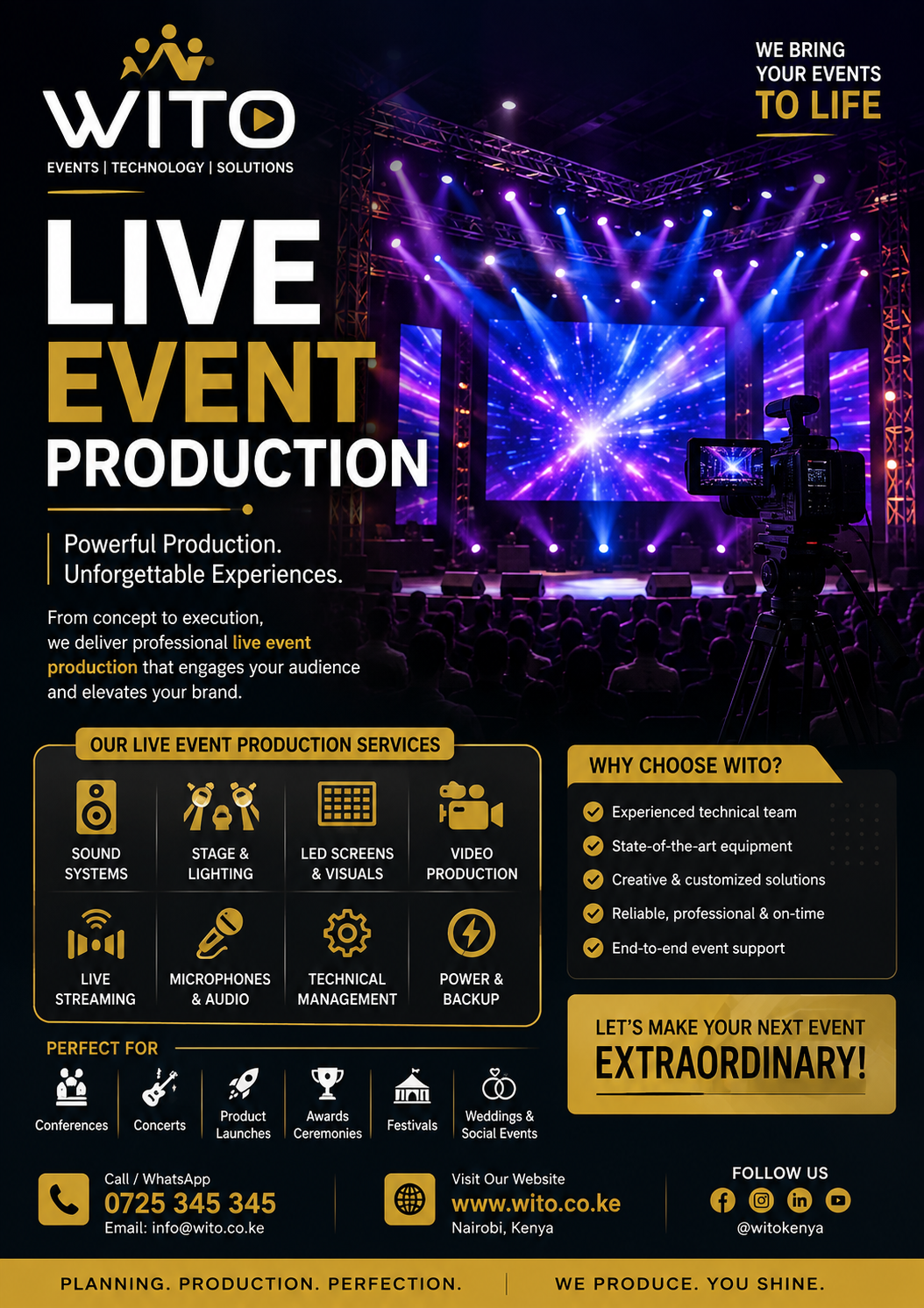
Live event production is the process of transforming an event concept into a fully executed live experience through professional staging, sound, lighting, video, technical management, and on-site production support. Whether you’re organizing a concert, corporate conference, product launch, festival, award ceremony, religious gathering, or public event, professional live production ensures that every technical element works together seamlessly.
Modern audiences expect more than simply attending an event. They want clear sound, impressive visuals, engaging lighting, smooth presentations, and experiences that remain memorable long after the event ends. This is why professional production has become an important part of successful events across Kenya and beyond.
A well-executed production combines creative design with technical expertise. It involves planning the stage, selecting appropriate equipment, positioning speakers and LED screens, programming lighting, coordinating cameras, managing presentations, and providing technical support throughout the event.
For organizers, working with an experienced production team can reduce technical risks while allowing them to concentrate on guests, speakers, performers, sponsors, and the overall event experience.
Table of Contents
ToggleWhat Is Live Event Production?
Live event production refers to the technical and creative processes involved in delivering an event in real time. It covers everything required to ensure an audience can see, hear, and experience the event effectively.
Unlike event planning, which focuses heavily on logistics such as venues, schedules, catering, invitations, and guest management, production focuses on the technical execution of the event.
A production team may be responsible for:
- Stage construction
- Sound systems
- Microphones
- Lighting
- LED screens
- Cameras
- Video switching
- Projectors
- Live streaming
- Power distribution
- Technical rehearsals
- Rigging
- On-site technical support
These components must work together throughout the event.
For example, during a corporate conference, a speaker may walk onto the stage while the lighting changes, a microphone becomes active, their presentation appears on the LED screen, and a camera feed is displayed to the audience. All these actions require careful coordination between production technicians.
Why Live Event Production Matters
An event can have excellent speakers, talented performers, and a beautiful venue, but poor technical execution can negatively affect the entire experience.
Professional live event production helps organizers create a consistent and engaging environment.
Better Audience Experience
Clear audio and high-quality visuals make it easier for attendees to follow presentations and performances.
Large venues can present challenges because people sitting at the back may struggle to hear speakers or see the stage. Professional production teams use appropriate sound reinforcement and video displays to improve visibility and coverage.
Professional Brand Image
Corporate and commercial events are opportunities to showcase a company’s brand.
A professionally designed stage, coordinated lighting, branded LED screens, and reliable presentation systems create a polished image that reflects positively on the organization.
Technical Reliability
Live events cannot simply be paused while technicians troubleshoot equipment.
Professional production teams therefore test equipment before the event and prepare backup systems where necessary.
This can include:
- Backup microphones
- Spare cables
- Additional playback systems
- Backup power
- Secondary communication systems
- Replacement LED panels
- Redundant streaming equipment
Preparation reduces the likelihood of major disruptions.
Key Components of Live Event Production
Successful production depends on several interconnected components.
Stage Production
The stage provides the central platform for speakers, performers, presenters, and ceremonies.
Stage production may include:
- Stage platforms
- Stairs
- Backdrops
- Trusses
- Scenic elements
- Podiums
- Catwalks
- LED screens
- Branding structures
The design should consider audience sightlines, venue dimensions, equipment requirements, and safety.
Audio Production
Sound is one of the most important parts of any live event.
Professional audio production includes:
- Main speaker systems
- Subwoofers
- Wireless microphones
- Headset microphones
- Lapel microphones
- Digital mixing consoles
- Stage monitors
- Audio processors
- Communication systems
Sound engineers monitor the audio throughout the event and make adjustments when necessary.
Lighting Production
Lighting can dramatically change the atmosphere of a venue.
Professional lighting may include:
- Moving head lights
- LED PAR lights
- Spotlights
- Wash lights
- Beam fixtures
- Uplighting
- Architectural lighting
- Follow spots
Lighting programmers can synchronize effects with music, presentations, performances, and important event moments.
Stage Production and Design
Stage design is more than placing a platform in front of an audience. It is about creating an environment that supports the purpose and identity of the event.
For a conference, the stage may feature a large LED screen, branded backdrop, lectern, confidence monitors, and presentation equipment.
For a concert, the stage may include:
- Large LED walls
- Lighting trusses
- Speaker arrays
- Artist monitors
- Backline equipment
- Special effects
For a product launch, the stage can incorporate branded graphics, product reveal areas, presentation screens, and synchronized lighting.
A professional production team considers the entire audience experience when developing the stage design.
Professional Sound Production
Poor audio can quickly reduce the quality of an event.
Even when an audience cannot identify the specific technical problem, unclear speech, excessive feedback, uneven volume, or distorted music can make an event uncomfortable.
Professional sound production starts with understanding the venue.
Engineers consider:
- Venue size
- Audience capacity
- Room acoustics
- Stage location
- Speaker positioning
- Event type
- Number of presenters
- Number of performers
A conference may require several wireless microphones and speech-focused speakers, while a concert requires significantly more powerful systems capable of reproducing vocals, instruments, and low frequencies.
Digital Mixing
Modern digital mixing consoles allow technicians to control multiple audio sources from a centralized location.
Engineers can adjust:
- Microphone levels
- Music
- Video playback
- Equalization
- Effects
- Monitor mixes
This creates a balanced and professional listening experience.
Wireless Microphones
Wireless microphones are particularly useful for conferences, award ceremonies, interviews, and presentations.
Common types include:
- Handheld microphones
- Lavalier microphones
- Headset microphones
- Wireless podium microphones
Proper frequency management is essential when multiple wireless devices are being used simultaneously.
Event Lighting Production
Lighting serves both practical and creative purposes.
A well-designed lighting system ensures the audience can see performers and speakers while creating an atmosphere appropriate for the occasion.
Corporate events may use clean and professional lighting designs, while concerts and festivals can use dynamic colors, movement, beams, and effects.
Lighting can also support branding by incorporating company colors into the production design.
Intelligent Lighting
Moving head fixtures allow production teams to change direction, focus, color, intensity, and movement during the event.
These fixtures are commonly used for:
- Concerts
- Award ceremonies
- Product launches
- Fashion shows
- Conferences
- Festivals
Architectural Lighting
Architectural lighting can transform the venue itself.
Walls, entrances, columns, stages, and other structures can be illuminated to create a cohesive visual environment.
LED Screens and Video Displays
Large LED displays have become an important component of modern live event production.
They allow audiences to see presentations, videos, branding, live camera feeds, and event graphics from virtually any position within the venue.
LED displays are useful for:
- Concerts
- Conferences
- Product launches
- Exhibitions
- Award ceremonies
- Festivals
- Outdoor events
Their brightness and scalability make them particularly effective for large venues.
Live Camera Feeds
Cameras positioned around the stage can transmit real-time images to LED screens.
This is especially useful when the venue is large and audience members at the back cannot see performers or speakers clearly.
Branded Content
LED screens can display:
- Company logos
- Sponsor messages
- Event schedules
- Presentations
- Promotional videos
- Speaker names
- Social media content
This creates additional opportunities for sponsors and event organizers to increase visibility.
Video Production and Camera Coverage
Professional video production allows an event to reach beyond the physical venue.
Multi-camera production can capture different perspectives, including:
- Wide stage shots
- Speaker close-ups
- Audience reactions
- Performer angles
- Product demonstrations
- Interviews
A video director coordinates camera feeds and determines which shots appear on the main screens or online broadcast.
This creates a more dynamic viewing experience.
Live Streaming
Live streaming has expanded the reach of modern events.
Instead of limiting an event to people who can physically attend, organizers can broadcast the experience to remote audiences.
Professional streaming may include:
- Multiple cameras
- Video switching
- Professional audio feeds
- Graphics
- Remote speakers
- Online chat
- Recording
- Social media broadcasting
This is particularly valuable for conferences, corporate meetings, product launches, religious events, and large public gatherings.
Technical Event Management
Behind every successful event is a technical team coordinating multiple systems simultaneously.
A production manager may oversee:
- Sound engineers
- Lighting technicians
- Video operators
- Camera operators
- Stage managers
- Streaming technicians
- Riggers
- Electricians
The production manager ensures everyone understands the event schedule and technical cues.
Before the audience enters the venue, the team should conduct system checks and rehearsals.
This preparation ensures that when the event begins, every technical element is ready to operate as planned.
Live Event Production for Different Types of Events
The technical requirements of an event depend heavily on its purpose, audience, venue, and program. Professional live event production teams adapt their equipment and approach to meet the specific needs of each event.
Corporate Live Events
Businesses organize numerous events throughout the year, including conferences, seminars, annual meetings, product launches, networking sessions, and employee celebrations.
Corporate productions often require a professional and polished environment.
Typical requirements include:
- Conference stages
- LED screens
- Presentation systems
- Wireless microphones
- Professional lighting
- Video recording
- Live streaming
- Branding displays
- Speaker confidence monitors
The production team coordinates closely with organizers and presenters to ensure presentations, videos, speeches, and panel discussions run according to schedule.
A reliable technical setup is especially important when senior executives, investors, clients, or international partners are attending.
Concert and Music Event Production
Concerts require some of the most sophisticated live event production systems because they combine powerful audio, dynamic lighting, video, stage design, performers, and large audiences.
A concert production may include:
- Main stage
- Line array sound systems
- Subwoofers
- Stage monitors
- LED video walls
- Moving lights
- Follow spots
- Artist microphones
- Backline equipment
- Camera systems
- Power distribution
- Stage management
Production teams also work with artists and their technical riders to ensure specific equipment requirements are available.
Artist Support
Professional production crews coordinate with performers before the event to understand their requirements.
This can include:
- Microphone preferences
- Monitor mixes
- Instrument requirements
- Stage positioning
- Lighting preferences
- Video content
- Performance cues
Good coordination helps artists perform confidently while providing audiences with an engaging experience.
Festival Production
Festivals introduce additional production challenges because they often take place outdoors and involve large audiences.
A festival may require several interconnected production systems.
These can include:
- Main stage production
- Secondary stages
- Large-format LED screens
- Long-range sound systems
- Delay speakers
- Outdoor lighting
- Generator systems
- Communication systems
- Video production
- Live streaming
Weather planning is particularly important for outdoor festivals.
Production companies must consider rain, wind, dust, temperature, and other environmental factors when selecting and installing equipment.
Conference Production
Conferences depend heavily on clear communication. Attendees must be able to hear speakers, see presentations, and follow discussions without technical distractions.
Professional conference production includes:
- Stage design
- Podium microphones
- Wireless microphones
- Presentation switching
- LED screens
- Projectors
- Confidence monitors
- Speaker timers
- Video recording
- Live streaming
Panel Discussions
Panel discussions require careful microphone and camera management.
Each panelist may need an individual microphone while cameras capture different speakers.
A technical director coordinates the presentation so the audience can follow the discussion easily.
Product Launch Production
Product launches are designed to create excitement and generate attention around a new product or service.
Professional live event production can turn a product reveal into a memorable experience.
Production elements may include:
- Custom stage design
- Large LED displays
- Product reveal lighting
- Promotional videos
- Professional sound
- Camera production
- Live streaming
- Branded graphics
- Interactive demonstrations
Lighting and video can be synchronized to create anticipation before the product is revealed.
Award Ceremony Production
Award ceremonies depend heavily on timing and presentation.
Each recipient may need to walk onto the stage while their name, photo, or company appears on an LED screen.
Production teams coordinate:
- Walk-on music
- Lighting cues
- Award graphics
- Microphones
- Camera shots
- Winner announcements
- Video playback
A professional production creates a prestigious atmosphere while ensuring the ceremony follows its schedule.
Wedding and Social Event Production
Although weddings are primarily social celebrations, they increasingly use sophisticated production technology.
Modern wedding production may include:
- Wedding stages
- Decorative lighting
- Sound systems
- Wireless microphones
- LED screens
- Dance floor lighting
- Video projection
- Live streaming
- Camera coverage
Lighting can transform the venue throughout different parts of the celebration.
For example, soft ambient lighting may be used during dinner, while dynamic lighting can create energy during the entertainment portion.
Exhibition and Trade Show Production
Trade shows require businesses to attract attention in environments where multiple companies compete for visitors.
Professional production solutions can include:
- Exhibition booth lighting
- LED displays
- Product demonstration screens
- Presentation stages
- Public address systems
- Digital signage
- Video walls
- Interactive displays
High-quality visuals help exhibitors communicate product benefits quickly and effectively.
Outdoor Live Event Production
Outdoor events require specialized planning because production equipment is exposed to environmental conditions.
Professional teams assess the venue before installation.
Important considerations include:
Weather
Rain and wind can affect staging, lighting, LED screens, and electrical systems.
Power
Outdoor venues may not have sufficient electricity, requiring temporary power systems.
Audience Coverage
Large outdoor spaces require carefully designed audio systems to ensure consistent coverage.
Cable Management
Cables must be routed safely to prevent trip hazards and protect equipment.
Equipment Protection
Sensitive electronics should be protected from moisture, dust, and other environmental conditions.
Indoor Live Event Production
Indoor venues provide more controlled environments but still require detailed technical planning.
Production teams assess:
- Ceiling height
- Rigging points
- Room dimensions
- Power availability
- Acoustics
- Lighting
- Seating arrangement
- Loading access
The production design should fit the venue rather than forcing equipment into unsuitable spaces.
Live Event Production for Hybrid Events
Hybrid events combine physical attendance with virtual participation.
Professional production makes it possible for remote audiences to experience an event through high-quality broadcasts.
A hybrid setup can include:
- Multiple cameras
- Live video switching
- Professional audio
- Streaming encoders
- Presentation feeds
- Remote speakers
- Virtual Q&A
- Online audience interaction
The production team must ensure that both physical and virtual audiences receive clear audio and visuals.
Event Power and Backup Systems
Power is one of the most critical components of live event production.
Sound systems, LED screens, lighting, cameras, computers, and streaming equipment all require reliable electricity.
Production teams calculate power requirements before the event.
Depending on the venue, solutions may include:
- Generators
- Backup generators
- UPS systems
- Distribution boards
- Voltage protection
- Dedicated circuits
Backup power is particularly important for major events where a sudden outage could interrupt performances or presentations.
Event Rigging and Structural Production
Large events often require equipment to be suspended above the stage.
Lighting fixtures, speakers, LED screens, and other equipment may be attached to trusses or approved rigging structures.
Professional rigging requires careful consideration of:
- Equipment weight
- Suspension points
- Load capacity
- Structural integrity
- Safety systems
- Equipment positioning
Only appropriately qualified personnel should handle complex rigging operations.
Event Communication Systems
Large productions involve many technicians working simultaneously.
Effective communication allows teams to coordinate activities quickly.
Production communication systems may connect:
- Stage managers
- Lighting operators
- Audio engineers
- Camera operators
- Video operators
- Streaming teams
- Security personnel
- Event organizers
Clear communication becomes particularly important during live performances when multiple cues need to happen at precisely the right time.
Technical Rehearsals
Rehearsals are an essential part of professional live event production.
Before guests arrive, the production team should test every major component.
Rehearsals may cover:
- Microphone checks
- Presentation playback
- Video transitions
- Lighting cues
- Camera positions
- Speaker entrances
- Music cues
- Product demonstrations
- Streaming
- Stage movements
A full rehearsal allows technicians to identify problems while there is still time to fix them.
Event Production Technology
Technology continues to change how live events are designed and delivered.
Modern production companies increasingly use:
- High-resolution LED displays
- Wireless production equipment
- Advanced digital consoles
- Automated lighting
- Real-time video switching
- Remote production
- Cloud-based collaboration
- Interactive displays
- Audience engagement technology
These technologies allow organizers to create more immersive experiences while improving operational efficiency.
Creating Immersive Event Experiences
Modern audiences increasingly expect events to provide memorable experiences rather than passive observation.
Production teams can combine:
- Lighting
- Sound
- Video
- Stage design
- Special effects
- Interactive technology
to create immersive environments.
For example, a product launch can use synchronized LED visuals, music, lighting, and stage effects to build anticipation before revealing the product.
Similarly, a conference can use dynamic visual content to maintain audience attention between keynote sessions.
Sustainable Live Event Production
Environmental sustainability is becoming increasingly important in the events industry.
Production companies can reduce environmental impact through:
- Energy-efficient LED lighting
- Reusable stage structures
- Digital signage
- Efficient transportation
- Rechargeable equipment
- Responsible waste management
- Energy-efficient displays
LED lighting, for example, can provide powerful illumination while consuming less energy than many traditional lighting technologies.
Why Professional Live Event Production Matters
Working with an experienced production team provides several advantages.
Reliability
Professional technicians test equipment and prepare contingency plans.
Better Quality
Modern production equipment produces clearer audio, sharper visuals, and more engaging lighting.
Technical Expertise
Experienced crews understand how different systems interact and can troubleshoot problems quickly.
Safety
Professional teams plan equipment installation, electrical systems, staging, and rigging with safety in mind.
Better Audience Experience
A seamless technical experience allows attendees to focus on the event rather than equipment problems.
Live Event Production Planning Process
Successful live event production begins weeks or months before the audience enters the venue. Professional production teams follow a structured process that allows them to understand the event objectives, identify technical requirements, prepare equipment, and coordinate the production crew.
A detailed production plan reduces last-minute problems and ensures every technical element supports the event program.
1. Initial Client Consultation
The process normally begins with a consultation between the event organizer and production company.
The production team needs to understand:
- Type of event
- Event objectives
- Expected attendance
- Venue
- Event date
- Program schedule
- Number of speakers
- Performers
- Branding requirements
- Budget
- Streaming requirements
This information helps determine the appropriate production approach.
2. Venue Site Inspection
A site inspection allows production specialists to understand the physical characteristics of the venue.
The team evaluates:
- Stage area
- Audience seating
- Ceiling height
- Rigging points
- Electrical capacity
- Loading areas
- Internet connectivity
- Camera positions
- Equipment access
- Emergency exits
A venue inspection is particularly important for large productions because equipment requirements can vary significantly from one location to another.
3. Production Design
After assessing the venue, the production team develops a technical design.
The design may include:
- Stage layout
- LED screen dimensions
- Speaker positions
- Lighting locations
- Camera positions
- Control desk placement
- Cable routes
- Power distribution
- Branding elements
Production drawings help the technical team understand exactly how the event will be installed.
Equipment Selection
The production team selects equipment based on the event’s requirements rather than simply using the largest available systems.
For example, a small corporate meeting may only need several wireless microphones, a presentation display, and compact speakers.
A large concert may require:
- Line array systems
- Large LED walls
- Subwoofers
- Multiple lighting fixtures
- Camera systems
- Stage monitors
- Generators
- Communication equipment
Choosing the right equipment improves performance while preventing unnecessary expenses.
Equipment Testing and Preparation
Before equipment reaches the venue, technicians should inspect and test it.
Testing can include:
- Microphone checks
- Speaker testing
- LED panel testing
- Camera testing
- Lighting checks
- Cable inspection
- Mixer configuration
- Streaming tests
- Power testing
Pre-event preparation gives the production team an opportunity to identify faulty equipment before installation.
Installation and Setup
Once equipment reaches the venue, the technical crew begins installation.
Depending on the event, setup may include:
- Stage construction
- Truss installation
- Speaker deployment
- LED wall assembly
- Lighting installation
- Camera setup
- Control room setup
- Power distribution
- Cable management
- System testing
Large events may require several days of setup.
Technical Rehearsal
A technical rehearsal is one of the most important stages of live event production.
The production team works through the event schedule to verify that all technical cues operate correctly.
This can include:
- Speaker microphone checks
- Presentation testing
- Video playback
- Lighting cues
- Camera switching
- Music playback
- Stage entrances
- Product demonstrations
- Streaming
- Award presentations
Rehearsals reduce technical surprises during the actual event.
On-Site Production Management
During the event, the production manager coordinates the technical team and communicates with event organizers.
The production manager monitors:
- Event schedule
- Technical cues
- Crew performance
- Equipment
- Presenters
- Stage activities
- Unexpected changes
A professional production manager serves as the central point of communication between the technical crew and event organizers.
Event Safety and Risk Management
Safety should always be a priority when planning live event production.
Events can involve large structures, electrical equipment, suspended equipment, crowds, performers, and temporary installations.
Electrical Safety
Production teams should ensure cables are properly routed and electrical systems are installed safely.
Power distribution should account for the requirements of:
- Sound systems
- Lighting
- LED screens
- Cameras
- Computers
- Streaming equipment
Backup power should also be considered for critical events.
Stage Safety
Stages and temporary structures must be properly assembled and inspected before use.
Access stairs, ramps, and other entry points should remain safe and accessible.
Rigging Safety
Suspended equipment must be installed using appropriate equipment and qualified personnel.
This is particularly important for:
- Speakers
- Lighting fixtures
- LED screens
- Trusses
- Other overhead equipment
Crowd Safety
Large events require appropriate access and emergency routes.
Production teams should coordinate with event organizers, venue management, and security personnel to ensure safe crowd movement.
Common Live Event Production Mistakes
Poor production planning can create unnecessary problems.
Insufficient Planning
Starting production planning too late can lead to equipment shortages and rushed installation.
Early planning provides enough time to identify problems and develop solutions.
Inadequate Sound Coverage
Using equipment that is too small for the venue can result in poor audio quality.
Sound systems should be designed according to venue size and audience distribution.
Poor Screen Placement
LED screens should be positioned where the entire audience can see them clearly.
Screen height, viewing angles, and seating arrangements should be considered during production design.
Ignoring Internet Requirements
Hybrid events and live streams require reliable internet connectivity.
Testing the connection before the event can prevent streaming disruptions.
No Backup Equipment
Unexpected equipment failure can disrupt an event.
Professional production teams prepare backup microphones, cables, playback systems, power solutions, and other critical equipment.
How Much Does Live Event Production Cost?
The cost of live event production depends on the complexity of the event.
Factors that influence pricing include:
- Number of attendees
- Event duration
- Venue
- Stage size
- Sound requirements
- Lighting requirements
- LED screen size
- Number of cameras
- Streaming requirements
- Crew size
- Transportation
- Power requirements
- Event location
A small conference may require a relatively simple production setup, while a large outdoor festival can require extensive staging, audio, lighting, video, power, and technical crews.
Rather than focusing only on the cheapest quotation, event organizers should evaluate the equipment quality, technical expertise, backup plans, and services included in the quotation.
Choosing the Right Live Event Production Company
Choosing the right production partner can determine whether an event runs smoothly or experiences avoidable technical problems.
Experience
Review the company’s experience with similar events.
A company that regularly produces conferences may have different strengths from one specializing primarily in concerts.
Equipment
Ask about the equipment available and whether it is professionally maintained.
Important equipment may include:
- Professional sound systems
- LED screens
- Lighting equipment
- Cameras
- Digital mixers
- Streaming equipment
- Power systems
Technical Crew
Experienced technicians are essential.
Ask whether the company provides:
- Sound engineers
- Lighting technicians
- Video operators
- Camera operators
- Stage managers
- Streaming technicians
- Production managers
Portfolio
Review previous productions to evaluate the company’s capabilities and production quality.
Backup Plans
Ask how the company handles equipment failures, power interruptions, internet problems, and other unexpected situations.
On-Site Support
The production team should remain available throughout the event rather than leaving immediately after installation.
Benefits of Professional Live Event Production
Hiring professional production specialists provides several advantages.
Better Technical Quality
Professional equipment and experienced operators improve audio, lighting, and video quality.
Reduced Risk
Production teams identify potential problems before they affect attendees.
Better Time Management
Experienced crews understand how to coordinate setup, rehearsals, and event schedules efficiently.
Stronger Audience Engagement
Dynamic visuals, lighting, and clear sound make events more engaging.
Professional Brand Image
High-quality production demonstrates professionalism and attention to detail.
Post-Event Content
Professional camera production can provide recordings, highlight videos, and promotional content for future marketing.
Measuring Event Production Success
After an event, organizers should evaluate whether the production achieved its objectives.
Useful metrics include:
- Attendance
- Audience satisfaction
- Social media engagement
- Online viewers
- Lead generation
- Sponsor visibility
- Technical incidents
- Stream quality
- Presentation quality
Feedback from attendees, speakers, sponsors, and organizers can identify opportunities for improvement.
Frequently Asked Questions
What does live event production include?
Live event production can include staging, sound, lighting, LED screens, video production, cameras, live streaming, power distribution, technical management, rigging, and on-site support.
What types of events require live event production?
Professional production is suitable for concerts, conferences, corporate events, festivals, product launches, weddings, exhibitions, award ceremonies, religious events, government functions, and sporting events.
Can live events be streamed online?
Yes. Professional production teams can use multiple cameras, professional audio, video switching, graphics, and streaming technology to broadcast events to online audiences.
Why is professional sound important?
Clear sound ensures attendees can understand speeches, presentations, announcements, and performances regardless of where they are seated.
What is the role of an event production manager?
The production manager coordinates the technical team, equipment, schedule, rehearsals, technical cues, and on-site production operations.
How early should production planning begin?
Large or complex events should ideally begin production planning several weeks or months before the event. Early planning provides enough time for venue inspections, equipment preparation, technical design, rehearsals, and contingency planning.
Conclusion
Professional live event production brings together technology, creativity, technical expertise, and careful planning to create successful live experiences. From stage design and sound systems to lighting, LED screens, video production, live streaming, power management, and technical support, every component plays an important role in the final event experience.
Whether you are organizing a corporate conference, concert, festival, product launch, wedding, exhibition, or public gathering, professional production can help you deliver a smoother and more engaging event.
The best productions begin with detailed planning. A thorough venue assessment, appropriate equipment selection, technical rehearsal, experienced production crew, reliable backup systems, and strong communication can significantly reduce technical risks.
As event technology continues to develop, organizers have more opportunities to create immersive and interactive experiences. High-resolution LED displays, advanced lighting, multi-camera production, hybrid event technology, and professional live streaming are changing how audiences experience events.
Ultimately, successful live event production is about more than equipment. It is about bringing every technical element together to support the event’s purpose, engage the audience, strengthen the brand, and create an experience people remember.
- live event production
- live event production
- live event production
- live event production
- live event production
- live event production
- live event production
- live event production
- live event production
- live event production
- live event production
- live event production